
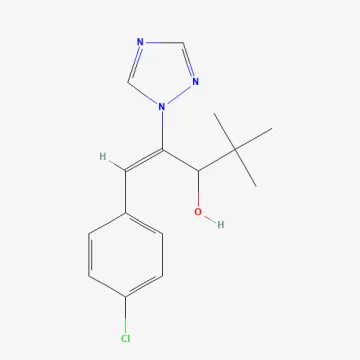
Uniconazole
Description
Mode of action
Uniconazole belongs to the triazole chemical class and serves as a powerful plant growth regulator with both retardant and systemic fungicidal properties.
The primary mode of action involves suppressing gibberellin biosynthesis by inhibiting the activity of the ent-kaurene oxidase enzyme in the mevalonic acid pathway.
As a result of gibberellin synthesis inhibition, plants exhibit reduced cell division and elongation, which leads to shorter internodes and stronger stems.
In addition, the compound influences plant metabolism by redistributing photosynthetic products from vegetative organs to reproductive ones, improving fruit quality.
Its fungicidal activity stems from its interference with pathogenic fungal metabolism, effectively suppressing a wide range of diseases, including rusts and leaf spots.
What it targets
Uniconazole is applied to cereals, fruit trees, ornamental plants, and vegetable crops to prevent lodging and promote a compact growth habit.
Key application goals include reducing plant height, preventing excessive shoot growth, and increasing crop resistance to lodging caused by wind or rain.
The substance is effectively used for canopy architecture management in industrial orchards, simplifying maintenance and harvesting operations.
In floriculture, uniconazole is utilized to produce compact potted plants that display darker leaf coloration and larger, more robust inflorescences.
As a fungicide, the active ingredient manages fungal infection development during the active vegetative stage, providing integrated crop protection.
Rates and timing
Uniconazole application rates vary significantly depending on the crop species, growth stage, and specific agronomic objectives.
For field crops, applications are performed during active growth phases, avoiding stress conditions such as severe drought or extreme temperature fluctuations.
In horticulture, timing is strictly regulated: early applications aim to stop shoot elongation, while late applications focus on improving bud set.
It is essential to strictly adhere to the manufacturer's concentration guidelines to prevent excessive plant growth inhibition and metabolic suppression.
The optimal application time is during early morning or late evening hours to minimize evaporation and ensure better absorption by plant tissues.
Restrictions
Uniconazole usage requires rigorous control, as overdosing can lead to irreversible stunting and significant loss of crop yield.
The product should not be applied to weak or pest-infested plants, as it may further deteriorate their health and potentially cause plant death.
Operators must wear appropriate personal protective equipment for skin and respiratory protection, following all safety standards for pesticide handling.
Store the product in dry, dark warehouse facilities, out of the reach of children, animals, and away from any food or feed storage areas.
Avoid any release of working solutions into water bodies or sewage systems to prevent potential negative impacts on aquatic ecosystems.
Status in the European Union
Not approved in the EU
- CAS number
- 83657-22-1
- Category (EU)
- PG - Plant growth regulator
EU status is for reference only and does not replace national registration in your country.