
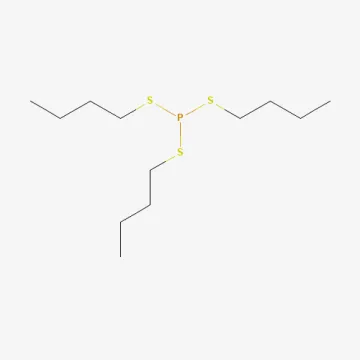
Tributylphosphorotrithioite
Description
Mode of action
Tributyl phosphorotrithioite is an organophosphorus compound widely used as a chemical defoliant in industrial agriculture to prepare crops for mechanical harvesting.
The substance functions by inducing premature leaf senescence through the stimulation of ethylene production within the plant tissue.
This biochemical process triggers the formation of an abscission layer at the base of the leaf petioles, which eventually leads to the detachment of leaves from the main stem.
Operating primarily through contact, the chemical efficiently eliminates foliage without causing systemic stress that could harm the overall quality of the fiber or seeds.
By streamlining the shedding process, it ensures that the harvesting machinery can operate smoothly, resulting in a cleaner and more profitable yield.
What it targets
The primary agricultural target for tributyl phosphorotrithioite is cotton, where foliage management is essential for efficient harvest logistics.
It is specifically applied to control the density of green vegetation on cotton plants, which typically hinders the mechanical picking of mature bolls.
Beyond leaf removal, the compound assists in the uniform opening of cotton bolls, which is critical for maximizing the economic output of the field.
It is important to note that this agent is not intended for weed management and acts strictly as a specialized growth regulator for technical crops.
The efficacy of the treatment is highly dependent on the physiological state of the crop and the timing of the application relative to boll maturation.
Rates and timing
The application rates for tributyl phosphorotrithioite must be strictly calibrated based on the specific crop condition and ambient environmental factors at the time of spraying.
Application is most successful when the cotton crop reaches a specific threshold of maturity, ensuring that the leaves are susceptible to the chemical's action.
Proper preparation of the spray solution is vital; the use of correct dilution ratios ensures maximum coverage and effective penetration into the plant canopy.
Environmental conditions, particularly temperature, play a significant role in the speed of the defoliation process, necessitating careful planning by field agronomists.
- Follow specific dosage instructions provided by the chemical manufacturer.
- Ensure adequate spray droplet size for uniform foliage coverage.
Restrictions
Tributyl phosphorotrithioite requires cautious handling due to its toxicological profile, necessitating the use of personal protective equipment by all field personnel.
Strict drift management protocols must be followed to prevent the contamination of surrounding areas, crops, or sensitive ecosystems nearby.
It is prohibited to apply the substance near water bodies, and appropriate buffer zones must be maintained to protect aquatic life and surrounding habitats.
Compliance with mandatory re-entry intervals is essential to ensure that field workers are not exposed to chemical residues after the application phase.
The chemical must be stored in specialized facilities that provide protection against extreme temperature fluctuations and direct sunlight to prevent degradation.
Status in the European Union
Not approved in the EU
- CAS number
- 150-50-5
- Category (EU)
- PG - Plant growth regulator
EU status is for reference only and does not replace national registration in your country.