
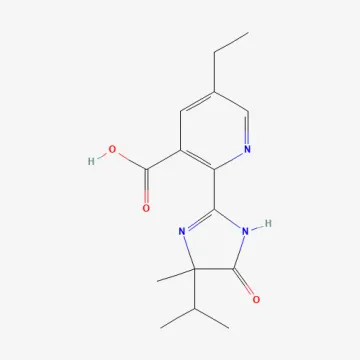
Imazethapyr
Description
Mode of action
Imazethapyr belongs to the imidazolinone chemical class. It is a systemic herbicide that is absorbed through both the root system and the aerial parts of weed plants.
The mechanism of action is based on the inhibition of the acetolactate synthase (ALS) enzyme, which leads to the cessation of the biosynthesis of essential amino acids: valine, leucine, and isoleucine.
As a result of protein synthesis disruption in susceptible plants, there is a rapid cessation of cell division and growth of weeds within hours after treatment.
Complete weed death occurs within 2–4 weeks. It is important to note that the substance also has residual soil activity, which allows for the suppression of secondary weed flushes.
Imazethapyr exhibits high selectivity toward crops, which are capable of rapidly metabolizing and neutralizing the active ingredient within their tissues.
What it targets
This substance effectively suppresses a wide range of annual and perennial grasses, as well as broad-leaved weed species.
Products based on imazethapyr successfully control difficult species such as common ragweed, pigweed species, common lambsquarters, black nightshade, and certain knotweed species.
It also shows suppressive activity against grass weeds, including foxtail, barnyard grass, and other weeds infesting legume fields.
The efficacy of the product is significantly higher when weeds are treated at early stages of active growth, when they are most vulnerable to ALS inhibitors.
Despite its high activity, imazethapyr may be less effective against weeds that have developed resistance to ALS-inhibitor herbicides.
Rates and timing
The application rates of imazethapyr depend on soil type, weed density, and crop growth stage; typically, they range from 0.4 to 1.0 liters of product per hectare.
The optimal application time for soybeans is the period from the appearance of the first to the third trifoliate leaf, when most weeds are at the cotyledon stage.
Application can be performed as a pre-emergence treatment (soil application) or post-emergence, depending on the specific product label.
When using soil application, it is crucial to have sufficient soil moisture in the top layer to activate the herbicide and facilitate absorption by germinating weeds.
The spray solution must uniformly cover the soil surface or the vegetative mass of weeds, which requires proper sprayer calibration and the use of high-quality nozzles.
Restrictions
A major limitation is the strict crop rotation schedule due to the long-term persistence of imazethapyr in the soil, which can adversely affect sensitive follow crops.
It is not recommended to plant cereals and other sensitive species in fields where imazethapyr was applied for a specific period (often 12 to 24 months).
Imazethapyr should not be applied in tank mixes with organophosphate insecticides, as this may increase phytotoxicity to the crop.
The use of the product is strictly prohibited on soils with low organic matter content or in areas where herbicide accumulation is possible due to specific moisture conditions.
When handling the substance, standard safety precautions must be followed: wear personal protective equipment, prevent drift to neighboring fields, and observe sanitary buffer zones.
Status in the European Union
Not approved in the EU
- CAS number
- 81335-77-5
- Category (EU)
- PG - Plant growth regulator
EU status is for reference only and does not replace national registration in your country.