
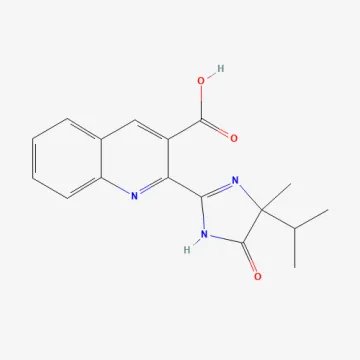
Imazaquin
Description
Mode of action
Imazaquin is a systemic herbicide belonging to the imidazolinone chemical class. It is absorbed by weeds through both the root system and foliage.
The mode of action involves the inhibition of the acetolactate synthase (ALS) enzyme. This enzyme is essential for the biosynthesis of branched-chain amino acids.
When the synthesis of valine, leucine, and isoleucine is blocked, plant growth ceases rapidly, followed by the death of the meristematic tissues.
Symptoms such as chlorosis and stunted development in the growing points appear shortly after application, leading to plant decay within several weeks.
Imazaquin provides residual activity in the soil, effectively preventing the emergence of subsequent flushes of weeds throughout the growing season.
What it targets
The compound is highly effective against a wide range of broadleaf weeds and certain grass species in specific legume crops.
It demonstrates excellent control over species such as common ragweed, pigweed, lambsquarters, black nightshade, and various knotweeds.
Imazaquin is particularly valued for its ability to eliminate competitive weeds that cause significant yield losses in soybean production.
The herbicide handles problematic and noxious weed species, making it a reliable tool for integrated weed management programs.
- Common ragweed (Ambrosia artemisiifolia)
- Redroot pigweed (Amaranthus retroflexus)
- Common lambsquarters (Chenopodium album)
- Black nightshade (Solanum nigrum)
- Jimsonweed (Datura stramonium)
Rates and timing
Imazaquin can be applied either as a pre-emergence or post-emergence treatment depending on the field's specific weed pressure and soil type.
For post-emergence applications, the ideal timing occurs when target weeds are in the early vegetative stage, typically between 2 to 4 true leaves.
Application rates are determined by the soil organic matter content and the specific weed composition present in the target area.
For soybean crops, the recommended application window usually falls between the first and third trifoliate leaf stages of the plant.
Proper calibration of spray equipment is mandatory to ensure uniform coverage and efficacy while maintaining environmental safety.
Restrictions
A major consideration for Imazaquin is its significant residual activity in the soil, which necessitates careful rotation planning.
Sensitive crops should not be planted in treated fields for a specified period, often 12 to 24 months, due to the risk of herbicide carryover.
Crops like sugar beets, rapeseed, and various vegetables are highly susceptible to Imazaquin residues and should be avoided in short-term rotations.
Environmental conditions such as drought or prolonged cold spells can exacerbate carryover risks by slowing the breakdown process of the chemical in the soil.
Strict precautions must be taken to prevent spray drift onto adjacent fields containing non-target crops to avoid potential phytotoxic damage.
Status in the European Union
Not approved in the EU
- CAS number
- 81335-37-7
- Category (EU)
- PG - Plant growth regulator
- Approved from
- 01.01.2009
- Approval until
- 31.12.2018
- ADI
- 0.25 mg/kg bw/day
- ARfD
- Not appl.
- AOEL
- 0.25 mg/kg bw/day
EU status is for reference only and does not replace national registration in your country.