
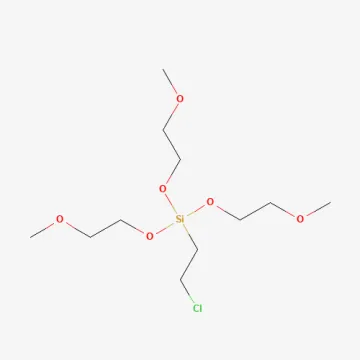
Etacelasil
Description
Mode of action
Etacelasil represents a group of compounds functionally related to organosilicon derivatives, possessing properties of growth regulators and adjuvant agents in plant protection products.
The mechanism of action of this group is based on the ability to modify the surface tension of the spray solution, ensuring deeper penetration of active components into plant tissues.
The group's preparations affect metabolic processes in weed cells, disrupting the synthesis of key enzymes necessary for their survival.
These compounds can also act as synergists, significantly enhancing the systemic activity of the main active ingredients of pesticides.
High biological efficiency is due to their ability to be rapidly absorbed by the leaf cuticle, minimizing active ingredient loss during rainfall.
What it targets
This group of substances is used to control a wide range of broad-leaved and grass weeds in cereal and technical crops.
Etacelasil is effective against resistant weed species that show tolerance to standard sulfonylurea group herbicides.
The use of these preparations is advisable in fields with high weed pressure where complex suppression of competing vegetation is required.
The substances help control such aggressive weeds as common lambsquarters, various thistle species, and common ragweed.
In specific agronomic schemes, Etacelasil is used to suppress secondary regrowth of weeds after the main herbicide treatment.
Rates and timing
Application rates for Etacelasil-based products vary depending on the species composition of weeds and their growth stage at the time of application.
The optimal time for application falls within the active growth phase of weeds, usually from the cotyledon stage to the 4-6 true leaf stage.
When preparing tank mixes, it is important to follow the sequence of adding components to ensure complete homogenization in the sprayer tank.
The working solution should be prepared immediately before use, as the efficiency of active ingredients may decrease during prolonged storage in water.
Agronomists recommend performing treatments at air temperatures between +12 and +25 degrees Celsius to achieve maximum biological effect.
Restrictions
It is not recommended to perform treatments during periods of extreme heat or strong wind to avoid drift to adjacent fields.
It is important to avoid applying Etacelasil on crops stressed by drought, frost, or pest damage.
To prevent the development of resistance in weeds, it is necessary to rotate the use of these preparations with herbicides of other chemical classes.
Personnel must use personal protective equipment for skin, respiratory, and eye protection when working with the substance.
Discharge of leftover spray solution into water bodies or sewage systems is strictly prohibited, requiring adherence to environmental regulations.
Status in the European Union
Not approved in the EU
- CAS number
- 37894-46-5
- Category (EU)
- PG - Plant growth regulator
EU status is for reference only and does not replace national registration in your country.