
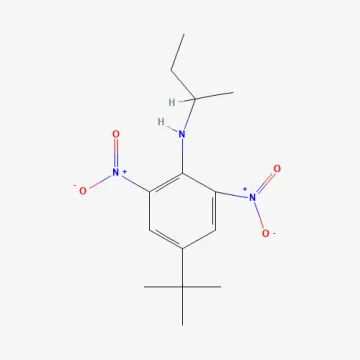
Butralin
Description
Mode of action
Butralin belongs to the dinitroaniline chemical class. It is a selective herbicide that affects plants primarily through the root system and seedlings, blocking the cell division process in susceptible species.
The mechanism of action is based on the inhibition of microtubules in meristematic tissues. This disruption halts the formation of the mitotic spindle, which leads to the immediate cessation of root and shoot growth in weeds during the earliest stages of their development.
The substance is not systemic and does not move through the tissues of mature plants, which is why it is most effective when applied before weed emergence. Once in the soil, butralin is strongly adsorbed by soil colloids, ensuring a long-lasting protective effect.
Products based on butralin can control weed populations for several weeks after application. The duration of this protective effect directly depends on soil type, moisture levels, and the intensity of solar radiation.
Effectiveness can be reduced if applied to very dry soil or in areas with excessive crop residues that prevent the uniform distribution of the herbicide barrier on the field surface.
What it targets
Butralin is designed to combat a wide range of annual grasses and some broadleaf weeds that germinate from seeds. It effectively suppresses the growth of aggressive species such as barnyard grass, foxtails, bluegrass, and others.
In the agricultural sector, the substance is widely used in soybeans, cotton, peanuts, and certain fruit and berry crops. This helps prevent weed competition with crops during the early stages of vegetation.
Using this product allows farmers to significantly reduce costs for mechanical weeding and cultivation, providing the crop with a weed-free space during the critical period of seedling formation.
It is important to note that butralin is less effective against perennial weeds with developed root systems, as its action is limited to the seed germination zone. To control perennials, tank mixes or alternative control methods are required.
As part of comprehensive crop protection programs, butralin is often used as a foundational soil component, providing control against the "second wave" of weeds when application regulations are followed.
Rates and timing
Application rates vary depending on soil type (humus content and mechanical composition) and the specific crop species. On light soils, minimum dosages are typically used, while on heavy and high-humus soils, maximum rates are applied.
Application is carried out before crop sowing with mandatory soil incorporation to a depth of 3–5 cm to prevent photodegradation of the substance by ultraviolet light. In some cases, application immediately after sowing is permitted if specified by the product label.
Waiting periods until harvest and the frequency of treatments are strictly regulated by local legislation. Failure to adhere to these timeframes can lead to the accumulation of residual amounts in marketable produce.
When preparing the working solution, it is essential to strictly follow the dosage instructions. Overdosing can negatively affect the development of crop root systems, causing stunted growth during early phases.
Agronomists recommend high-quality soil preparation before treatment: the soil should be finely granulated and free of large clods to ensure the herbicide barrier is as continuous and effective as possible.
Restrictions
Butralin is moderately toxic to warm-blooded animals, so the use of personal protective equipment, such as respirators, gloves, and protective suits, is mandatory during handling.
The substance poses a risk to aquatic organisms; therefore, discharging remaining working solutions into water bodies, wells, or drainage systems is strictly prohibited. It is necessary to maintain exclusion zones near water sources.
Special attention should be paid to crop rotation. Due to the active substance's ability to persist in the soil for a certain period, there may be restrictions on planting subsequent crops that are sensitive to dinitroaniline herbicides.
In case of contact with skin or mucous membranes, immediately rinse the affected area with plenty of running water. During operations, eating, drinking, or smoking is prohibited until the equipment has been decontaminated.
Store products in their original packaging, in dry and well-ventilated warehouses, out of reach of children and pets, strictly adhering to the temperature conditions specified by the manufacturer.
Status in the European Union
Not approved in the EU
- CAS number
- 33629-47-9
- Category (EU)
- PG - Plant growth regulator
EU status is for reference only and does not replace national registration in your country.