
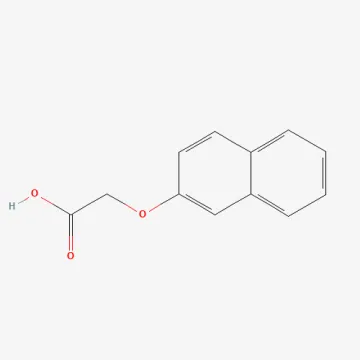
2-Naphthyloxyacetic acid
Description
Mode of action
2-naphthyloxyacetic acid, often abbreviated as BNOA, is a synthetic plant growth regulator belonging to the auxin chemical class. It functions by mimicking the biological activity of endogenous auxins, which are essential for cell elongation, tissue development, and organ formation in plants.
The primary mode of action involves stimulating metabolic pathways that prevent the formation of the abscission layer in flower stalks. By regulating the hormonal balance within the plant, it significantly reduces the premature dropping of flowers and young fruits caused by environmental stress.
This substance is widely recognized for its ability to induce parthenocarpy, a process where fruits develop and grow to maturity without the need for fertilization. This mechanism is particularly beneficial in greenhouses where pollination conditions are suboptimal.
By applying this regulator, growers can mobilize nutrients toward the reproductive parts of the plant. This directional transport supports the rapid development of ovary tissue, ensuring that the fruit reaches its full potential despite unfavorable climate conditions.
Due to its high physiological activity, the substance works at very low concentrations. It effectively coordinates the plant's resources to prioritize fruit development, which is critical for maintaining consistent yields in intensive cultivation systems.
What it targets
2-naphthyloxyacetic acid is primarily used on solanaceous crops, including tomatoes, peppers, and eggplants. It serves as a vital tool for farmers to manage fruit set in both open field and protected greenhouse environments.
The compound is targeted against flower and fruit abscission, which frequently occurs due to temperature fluctuations, low light intensity, or humidity stress. It acts as a safety net for crops during their most sensitive flowering stages.
In addition to vegetable crops, it has applications in berry production, such as strawberries, to enhance the rate of successful fruit formation after unexpected spring frosts that may damage natural reproductive structures.
By preventing the 'abortion' of blossoms, the use of this growth regulator ensures a higher percentage of harvestable produce. It is especially useful for early-season crops when native pollinators are not yet active enough to ensure effective fertilization.
The regulator is designed to protect the crop's yield potential, ensuring that the plants maintain productivity even when exposed to physiological triggers that would otherwise cause a loss of blossoms.
Rates and timing
Applications must be timed precisely with the crop's flowering phase, targeting the specific trusses or flowers. It is standard practice to spray the inflorescences directly while avoiding excessive contact with the vegetative parts of the plant.
Usage rates are extremely low, as high concentrations can result in negative effects such as leaf curling, stunted lateral growth, or fruit deformation. Growers must follow the specific dilution instructions provided for their target crop.
It is recommended to apply the solution during the cooler parts of the day, such as early morning or late evening. This minimizes evaporation and ensures that the plant absorbs the active ingredient effectively before the heat of the day.
The frequency of application is generally restricted to one or two treatments per flower cluster. Proper timing ensures that the regulator supports the entire developmental window of the fruit without causing an imbalance in the plant's hormonal cycle.
Precision equipment that produces a fine mist is required for application. This ensures that the active ingredient coats the blossom and pedicel uniformly without wasting product or causing saturation that could harm the plant tissue.
Restrictions
Operators must wear appropriate personal protective equipment, including gloves and safety goggles, when handling 2-naphthyloxyacetic acid. While it is not highly toxic, direct skin contact should be avoided to prevent irritation.
Users must be careful to avoid drift, especially when applying in open fields, as the substance is highly active and can affect sensitive neighboring crops. Applications should be suspended during windy conditions.
Storage requirements include keeping the container tightly sealed in a cool, dark, and dry place. The prepared working solution should be used immediately, as its chemical stability decreases rapidly once diluted with water.
Compatibility with other agrochemicals is a critical factor; mixing 2-naphthyloxyacetic acid with alkaline products should be avoided, as it may neutralize the auxin activity and render the treatment ineffective.
It is important to note that this growth regulator is a supplement to good agronomic practice, not a replacement for proper fertilization, irrigation, or pest management. Over-reliance on chemical regulators without adequate plant nutrition can lead to poor fruit quality.
Status in the European Union
Not approved in the EU
- Category (EU)
- PG - Plant growth regulator
- ADI
- 0.01 mg/kg bw/day
- ARfD
- 0.6 mg/kg bw
- AOEL
- 0.03 mg/kg bw/day
EU status is for reference only and does not replace national registration in your country.