
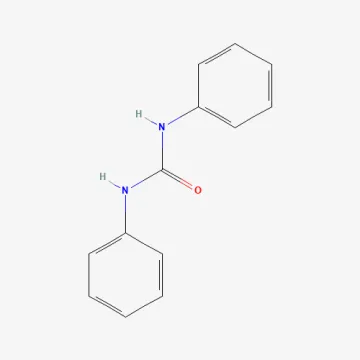
1,3-Diphenyl urea
Description
Mode of action
1,3-Diphenylurea belongs to a class of substituted urea derivatives that exhibit significant cytokinin-like biological activity. Unlike standard nitrogen fertilizers, this compound acts as a molecular signal that mimics the physiological processes of natural plant hormones.
The primary mechanism of action involves the stimulation of cell division (mitosis) within the plant's meristematic tissues. By interacting with cellular receptors, the substance triggers metabolic pathways that regulate shoot growth and organ development.
These compounds effectively delay leaf senescence, allowing plants to maintain photosynthetic activity for a longer duration. This is crucial for sustaining crop health during periods of environmental stress, such as heat waves or drought.
The substance facilitates the mobilization and redistribution of nutrients within plant tissues. By directing resources towards active growth points, it helps optimize the development of the crop during critical phenological stages.
At the biochemical level, 1,3-diphenylurea influences enzymes responsible for protein and nucleic acid synthesis. This property makes it a valuable component in the formulation of modern growth regulators designed to maximize agricultural yields.
What it targets
This group of compounds is used primarily as a plant growth regulator for a wide variety of agricultural crops, including cereals, vegetables, and fruit-bearing trees. Its goal is to improve both the quantity and quality of the harvest.
It is specifically applied to mitigate growth retardation caused by environmental stress. Factors like low temperatures, moisture deficiency, or the phytotoxic side effects of intensive pesticide use can be effectively countered by its application.
The substance is known to reduce the premature shedding of fruit in orchards. By stabilizing the development of young fruit, it ensures a better retention rate and contributes to uniform fruit size and ripening.
It is also employed to improve seed germination uniformity, ensuring that crops develop evenly across the entire field. This uniformity simplifies mechanical field operations and standardizes the harvesting process.
Furthermore, it helps crops manage stress induced by saline soils or the accumulation of toxic metabolites within plant tissues, ensuring that the plant retains its vegetative vigor even in suboptimal growing conditions.
Rates and timing
Application rates for 1,3-diphenylurea must be managed with high precision, as excessive amounts can lead to growth inhibition rather than stimulation. Doses are typically calculated in small quantities per hectare.
Timing is critical: applications should be synchronized with the plant's physiological needs, particularly during peak growth periods or intense cell division stages. This ensures the highest responsiveness of the plant to the treatment.
Compatibility with other agrochemicals must be verified before mixing. It is generally advised to avoid mixing with strong oxidizing agents or highly acidic formulations unless compatibility testing proves it is safe.
The application process requires careful calibration of equipment to ensure even coverage of the foliage. Uniform distribution is necessary for the efficient uptake of the growth regulator by the plant tissues.
The use of the substance should be integrated into a balanced crop management program. Combining it with foliar micronutrient applications often leads to a synergistic effect, enhancing the overall metabolic health of the crop.
Restrictions
Safety is paramount when handling substituted urea derivatives. Personnel must use appropriate personal protective equipment (PPE), including respiratory protection, gloves, and protective clothing to prevent skin and mucosal contact.
Exceeding recommended dosages is strictly forbidden. An overdose can disrupt the hormonal balance of the plant, potentially leading to negative physiological outcomes and a reduction in crop yield.
Environmental care must be taken to prevent drift into neighboring areas, water bodies, or protected habitats. Drift control measures are essential to protect local biodiversity, including pollinating insects.
The product must be stored in a cool, dry place away from direct sunlight, food, and feed. Keeping the container tightly sealed prevents moisture-related degradation of the active substance over time.
Disposal of expired products and empty containers must follow local environmental regulations. Improper disposal can lead to soil or water contamination, posing long-term risks to the local ecosystem.
Status in the European Union
Not approved in the EU
- CAS number
- 102-07-8
- Category (EU)
- PG - Plant growth regulator
EU status is for reference only and does not replace national registration in your country.