

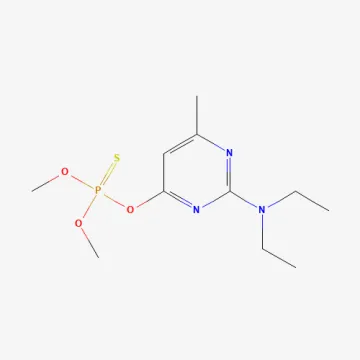
Description
Mode of action
Pirimiphos-methyl is a broad-spectrum organophosphate insecticide and acaricide that acts through contact, ingestion, and fumigation pathways.
The chemical acts by inhibiting the enzyme acetylcholinesterase, which is vital for the proper function of the nervous system in insects, leading to paralysis and death.
It possesses a significant vapor pressure, which allows it to act as a fumigant in enclosed storage spaces, effectively penetrating deep into grain bulks.
The active substance is known for its fast knockdown effect, rapidly incapacitating pests upon contact with treated surfaces or inhalation of vapors.
Once applied, the substance degrades in the environment, with the rate of dissipation depending on factors such as temperature, light exposure, and humidity.
What it targets
This active substance is highly effective against a diverse group of pests including Coleoptera, Lepidoptera, Homoptera, and various species of mites.
It is predominantly utilized in the post-harvest sector to control stored-product insects like the rice weevil, saw-toothed grain beetle, and Indian meal moth.
Beyond storage facilities, it is used in agriculture to manage aphids, thrips, and certain leaf-feeding larvae on various cereal, fruit, and vegetable crops.
It impacts both adult pests and their larval stages, offering a comprehensive solution for population management in agricultural settings.
The residue on treated surfaces remains active for a significant period, providing a protective layer that helps prevent re-infestation.
Rates and timing
Application rates are highly specific to the environment: warehouse surface treatments differ significantly from direct grain applications regarding dosage and method.
Surface treatments involve uniform spraying of empty bins and storage walls to establish an immediate defense barrier against migrating pests.
When protecting stored grain, the application is often performed using calibrated dispensers as the grain moves along a conveyor system to ensure even distribution.
Compliance with mandatory pre-harvest or pre-consumption intervals is essential to ensure that residue levels fall within safe regulatory limits for human consumption.
In the field, optimal dosages are determined based on the crop growth stage and the severity of pest pressure, ensuring minimal wastage and maximum efficacy.
Restrictions
Pirimiphos-methyl is toxic to mammals, requiring strict adherence to occupational safety protocols, including the use of respirators, protective clothing, and gloves.
The substance is extremely hazardous to bees; therefore, applications must be avoided during crop flowering and when bees are actively foraging in the area.
Extreme care must be taken to prevent runoff into aquatic ecosystems, as the chemical is highly toxic to fish and other aquatic organisms.
Proper ventilation of treated enclosures is a critical safety step before allowing personnel to re-enter or before moving grain for processing.
To mitigate the risk of pest resistance development, it is recommended to rotate the use of this insecticide with other classes of chemicals and avoid over-reliance.
Regulatory
Status in the European Union
Approved in the EU
- CAS number
- 29232-93-7
- Category (EU)
- IN - Insecticide
- Approved from
- 01.10.2007
- Approval until
- 31.01.2027
- ADI
- 0.004 mg/kg bw/day
- ARfD
- 0.15 mg/kg bw
- AOEL
- 0.02 mg/kg bw/day
Hazard classification (CLP)
Acute Tox. 4 - H302Aquatic Acute 1 - H400Aquatic Chronic 1 - H410
EU legislation
EU status is for reference only and does not replace national registration in your country.
Content graph
Connections · Pirimiphos-methyl
Most often together:
Marketplace
Products · 15

Aktual
Ф.Меатон Лімітед, Лондон, Великобританія.
Insecticides
0
0
·
921
12 offers
18.72 €per 1 l
Buy

Pirimivit
«Нанджин Ессенс Файн-Кемікал Ко. Лтд» (Китай)
Insecticides
0
0
·
690
1 offer
0.89 €per 1 l
Buy


Pirgren 50
Генеральна Компанія Інсектицидів , Франція
Insecticides
0
0
·
38
4 offers
1.66 €per 1 l
Buy


ANTI-ACARI-MAX
ТОВ «Фабрика агрохімікатів», Черкаси, Україна
Insecticides
0
0
·
35
7 offers
3.02 €per 1 l
Buy


Bisectrisa
Ф.Женьянг Джонгнонг Інд.,Ко,Лтд., Женьянг, Китай.
Insecticides
0
0
·
53
No offers
—
Details

