
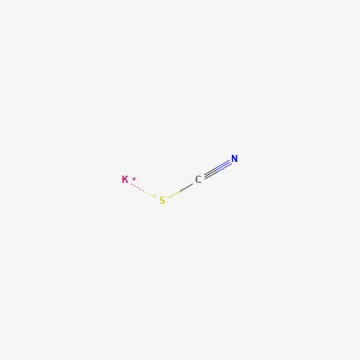
Potassium thiocyanate
Description
Mode of action
Potassium thiocyanate (KSCN) acts as a specialized chemical component in various plant protection formulations, often utilized for its unique ability to disrupt metabolic pathways.
The core mechanism of action involves the interference with cellular respiration and enzyme activity in target plant species or fungal pathogens, leading to rapid cell death.
Upon application, the substance effectively penetrates the cuticle layer, where it facilitates the rapid movement of ions, thereby triggering a systemic or contact response.
It acts as a potent inhibitor of oxidative phosphorylation in unwanted organisms, making it particularly useful when traditional herbicides fail to control resistant strains.
Environmental conditions, such as temperature and relative humidity, play a crucial role in the speed of uptake, allowing the substance to effectively target pests even under challenging field conditions.
What it targets
Potassium thiocyanate is primarily used as an active ingredient in herbicide formulations designed to eradicate broadleaf weeds that demonstrate tolerance to standard active substances.
It also plays a significant role in managing fungal outbreaks, providing effective control against various pathogens that affect leaves, stems, and fruits of agricultural crops.
In specialized horticulture, it serves as a management tool to suppress disease development in orchards and vineyards during the dormant or early growth periods.
The substance can be applied to seedbeds to mitigate the impact of soil-borne fungi that typically threaten the germination and early development of seedlings.
Additionally, it has been observed that specific concentrations can assist in controlled leaf abscission in certain industrial crops to facilitate efficient mechanical harvesting.
Rates and timing
The application rate must be carefully calibrated according to the specific crop and the severity of the infection or weed infestation to prevent phytotoxicity.
Proper timing is essential; for weeds, the best results are achieved when plants are in their active growth phase and lack protective physical barriers.
For fungal control, preventative application is encouraged, especially during periods known to be conducive to the development of disease outbreaks in the region.
The use of advanced spraying equipment is recommended to ensure uniform distribution and minimal waste of the product across the treated area.
Operators should combine the application with appropriate surfactants to ensure better adhesion to the leaf surface and enhanced penetration under varying climate conditions.
Restrictions
Safety is paramount when handling Potassium thiocyanate; all personnel must utilize personal protective equipment (PPE) to prevent accidental ingestion or inhalation.
It is strictly prohibited to eat, drink, or smoke while handling the concentrated product or the prepared spraying solution to avoid harmful exposure.
The product must be stored in its original, sealed container in a cool, dry, and secure location, well away from food, animal feed, and incompatible oxidizing agents.
To protect the environment, wash water and container remnants must be handled according to local environmental protection protocols, avoiding direct entry into water bodies.
In case of physical contact with the skin or eyes, it is imperative to flush the area with copious amounts of water immediately and seek medical consultation if irritation persists.
Status in the European Union
Not approved in the EU
- CAS number
- 333-20-0
- Category (EU)
- FU - Fungicide
EU status is for reference only and does not replace national registration in your country.