
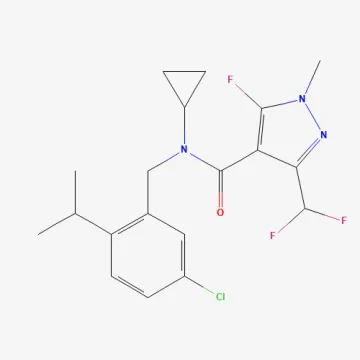
Isoflucypram
Description
Mode of action
Isoflucypram is a chemical fungicide belonging to the pyrazole-carboxamide class and acts as a Succinate Dehydrogenase Inhibitor (SDHI). It selectively binds to the mitochondrial enzyme complex of fungi, effectively disrupting the Krebs cycle and shutting down the pathogen's energy production.
Due to its high systemic activity, the substance is rapidly absorbed by plant tissues and transported via the vascular system. This translocation ensures that both existing foliage and newly emerging leaves receive reliable protection against infections.
Isoflucypram exhibits strong translaminar properties, allowing it to penetrate through the leaf surface to the underside. This is particularly beneficial for controlling pathogens that establish themselves on the lower canopy, ensuring thorough protection.
The active ingredient possesses both preventative and curative properties. It works by inhibiting spore germination, mycelial growth, and the development of specialized infection structures, such as haustoria, inside the plant tissue.
Furthermore, isoflucypram is characterized by its stability on the leaf surface and resistance to being washed off by rainfall. This provides a long-lasting protective barrier, which is essential for maintaining plant health during high-pressure periods.
What it targets
Isoflucypram is engineered to combat a wide spectrum of fungal pathogens that cause significant economic damage in agriculture. It is highly effective against various fungi classified as ascomycetes, basidiomycetes, and deuteromycetes.
In cereal production, it is primarily used to control leaf spot diseases, including Septoria tritici blotch and various Helminthosporium species. These diseases are notorious for causing early senescence and reducing grain filling.
The fungicide also demonstrates excellent efficacy against rust diseases, including brown and yellow rust. It restricts the expansion of pustules and limits the overall development of necrotic lesions on the leaf surface.
Powdery mildew represents another key target for isoflucypram. The compound effectively disrupts the fungal mycelial mat, preventing the secondary spread of the disease and allowing the crop to maintain optimal photosynthetic capacity.
By providing broad-spectrum control, isoflucypram helps decrease the overall inoculum pressure in fields, contributing to improved plant vigor and higher yield potential across various climatic conditions.
Rates and timing
Application rates for isoflucypram are determined by the specific crop, the target pathogen, and current local field conditions. It is typically applied during active growth stages, such as stem elongation and flag leaf development.
For optimal biological results, preventive application is highly recommended before the onset of visual infection symptoms. Under conditions of high disease pressure, sequential applications may be required to maintain control throughout the season.
Effective application requires uniform spray coverage of the plant canopy. It is essential to use appropriate water volumes to ensure the active ingredient reaches the lower parts of the plant, where humidity levels are higher and infection risk is greatest.
Harvest intervals are established to ensure product safety for the end consumer. These periods typically range from 30 to 45 days post-application, allowing for flexible use in integrated pest management programs without residue concerns.
Best results are achieved when applied during moderate weather conditions, ideally between 12°C and 25°C. Avoid application during periods of extreme drought or intense heat, as these factors may reduce the translocation efficiency of the systemic active ingredient.
Restrictions
To mitigate the risk of resistance development, isoflucypram should be used as part of an integrated disease management strategy. It is essential to rotate it with fungicides that possess different modes of action to maintain its effectiveness over time.
While isoflucypram is compatible with many common tank-mix partners, such as insecticides and herbicides, a physical compatibility test should always be conducted before mixing large quantities to prevent sedimentation or clogging.
Personnel handling the product must adhere to safety guidelines by using personal protective equipment, including gloves, goggles, and respiratory protection. Following these precautions minimizes the risk of dermal or respiratory exposure.
Environmental stewardship is a priority; therefore, prevent any spray drift or direct runoff into water bodies or drainage systems. Dispose of all product containers and rinse water in strict accordance with local environmental regulations.
Storage of the product should occur in a cool, dry, well-ventilated area protected from direct sunlight. Ensure containers are tightly sealed and kept away from unauthorized individuals, children, and livestock to prevent accidental contamination.
Status in the European Union
Pending
- CAS number
- 1255734-28-1
- Category (EU)
- FU - Fungicide
EU status is for reference only and does not replace national registration in your country.