
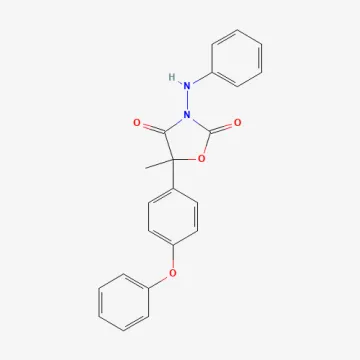
Famoxadone
Description
Mode of action
Famoxadone belongs to the oxazolidinedione chemical class and functions as a potent fungicide with both protective and curative properties. It works by inhibiting the mitochondrial respiration of pathogens by blocking electron transport at the cytochrome bc1 complex.
The substance possesses high lipophilicity, which enables it to rapidly penetrate the waxy layer of the leaf cuticle. This ensures strong adhesion to plant surfaces, providing excellent resistance against wash-off from rainfall.
The mode of action prevents the germination of spores and the development of mycelium, effectively stopping infection before it can establish itself within plant tissues.
Famoxadone exhibits translaminar activity, meaning it can redistribute within the leaf tissue to protect areas not directly contacted by the spray, ensuring a more uniform coverage.
It is predominantly used in formulated mixtures, which enhances its overall spectrum of activity and plays a vital role in preventing the emergence of resistant fungal strains.
What it targets
Famoxadone shows high efficacy against a broad spectrum of phytopathogens, particularly those belonging to the oomycete class, as well as certain ascomycetes.
It is widely recognized for its effectiveness in controlling late blight (Phytophthora infestans) in potatoes and tomatoes, a disease capable of causing severe crop devastation.
The fungicide is also utilized to combat downy mildew in various vegetable crops, including cucumbers and onions, maintaining plant health during high-risk weather conditions.
Furthermore, it provides significant control over various types of leaf spot diseases, such as early blight, supporting overall canopy integrity throughout the growing season.
By effectively targeting the reproductive and vegetative stages of these pathogens, Famoxadone remains an essential tool in modern integrated pest management programs.
Rates and timing
Application rates for Famoxadone are determined by the specific product formulation and must be adjusted based on the crop type and the severity of the infection pressure in the field.
Proactive application before the onset of disease symptoms is highly recommended to achieve maximum preventive control and maintain high yield potential.
Spray intervals typically range from 7 to 12 days, depending on environmental factors like humidity and temperature that influence the speed of pathogen development.
Thorough coverage of all plant parts is essential for success, requiring calibrated spray equipment to ensure the fungicide effectively reaches both the upper and lower leaf surfaces.
Adherence to pre-harvest intervals is mandatory to comply with international food safety standards and to ensure that agricultural products are free from chemical residues.
Restrictions
Famoxadone is classified as a substance requiring careful handling; therefore, operators must wear appropriate personal protective equipment during mixing and spraying.
Applications should not be made under conditions of extreme heat or strong wind to prevent drift and ensure optimal absorption into the plant surface.
To avoid the development of fungicide resistance, it is crucial to rotate the use of Famoxadone with products featuring different modes of action throughout the crop cycle.
Environmental precautions must be taken to prevent run-off into aquatic ecosystems, as the substance can be toxic to various aquatic organisms.
All containers must be stored in a cool, dry, and secure location away from livestock, food supplies, and unauthorized persons to ensure long-term safety.
Status in the European Union
Not approved in the EU
- CAS number
- 131807-57-3
- Category (EU)
- FU - Fungicide
- Approved from
- 01.10.2002
- Approval until
- 09.09.2021
- ADI
- 0.006 mg/kg bw/day
- ARfD
- 0.1 mg/kg bw
- AOEL
- 0.0024 mg/kg bw/day
EU status is for reference only and does not replace national registration in your country.