
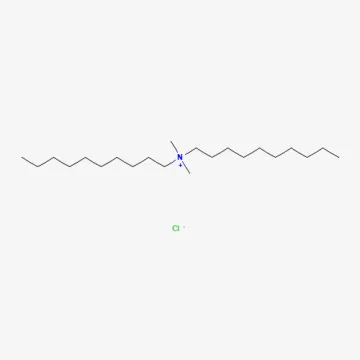
Didecyldimethylammonium chloride
Description
Mode of action
Didecyldimethylammonium chloride belongs to the class of quaternary ammonium compounds (QACs). It is a cationic surfactant that demonstrates potent antimicrobial activity by disrupting the membrane structures of pathogens.
The mechanism of action relies on the interaction between the positively charged nitrogen atom of the molecule and the negatively charged phospholipids in the cell walls of microorganisms. This results in the disruption of the cytoplasmic membrane and cell death.
The substance effectively inactivates the enzyme systems of pathogens, leading to irreversible disturbances in their energy metabolism. This process stops the growth of bacterial and fungal colonies.
High activity is observed even at low concentrations in the working solution. The molecule's stability across a wide pH range makes it a versatile tool for surface disinfection and tool maintenance.
The substance provides a prolonged effect by creating a protective film on treated surfaces, which prevents re-colonization by microorganisms for a significant period of time.
What it targets
Didecyldimethylammonium chloride is used as a broad-spectrum antiseptic against most Gram-positive and Gram-negative bacteria, yeasts, and molds.
In agriculture, it is commonly used for disinfecting greenhouses, storage facilities, containers, and harvesting equipment. It effectively suppresses phytopathogenic microflora to preserve produce during storage.
It is employed for the disinfection of drip irrigation systems, preventing the buildup of biofilms and algae that can clog emitters and contribute to the spread of root rot.
The substance can be part of tank mixes for disinfecting tools before grafting or pruning crops, preventing the transfer of viral diseases.
- Suppression of Aspergillus and Penicillium molds.
- Control of pathogens causing bacterial soft rot.
- Elimination of fungal spores on greenhouse structures.
- Prevention of secondary contamination of fruits during storage.
Rates and timing
Application rates depend directly on the purpose: for preventive disinfection, low-concentration solutions (from 0.05% to 0.2%) are used, while more intensive treatments require higher concentrations.
For disinfection of storage facilities, the product is applied by spraying at a rate of 100–300 ml of ready-to-use solution per square meter of surface area.
An exposure time of at least 30–60 minutes is required to ensure the elimination of pathogen spores. After treatment, surfaces in contact with produce should ideally be rinsed with water.
When flushing drip irrigation systems, the solution is passed through the system and left for a specific duration to dissolve organic deposits, followed by thorough flushing with clean water.
Treatment schedules are planned during periods when plants are absent in greenhouses or during the off-season to avoid phytotoxicity and ensure maximum sanitation.
Restrictions
Despite high effectiveness, Didecyldimethylammonium chloride should not come into direct contact with growing plants in high concentrations, as this may cause tissue burns.
Personnel must use personal protective equipment (gloves, goggles, respirators) during application, as the concentrated substance may cause skin and mucous membrane irritation.
Avoid releasing the product into water bodies or sewage systems, as cationic surfactants are toxic to aquatic organisms and can disrupt the biological balance in nature.
The product must not be mixed with anionic surfactants, as this leads to the rapid neutralization of the active ingredient and the loss of its disinfectant properties.
Storage should be carried out in tightly closed original packaging at positive temperatures, away from food products, and in places inaccessible to children and pets.
Status in the European Union
Not approved in the EU
- CAS number
- 7173-51-5
- Category (EU)
- FU - Fungicide
- ADI
- 0.12 mg/kg bw/day
- ARfD
- 0.12 mg/kg bw
EU status is for reference only and does not replace national registration in your country.