
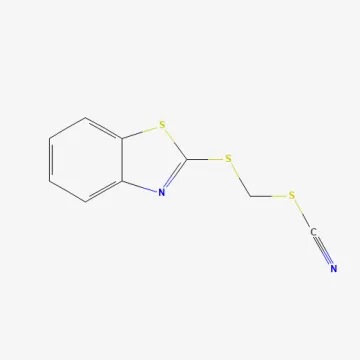
2-(thiocyanomethylthio)benzothiazole
Description
Mode of action
2-(thiocyanomethylthio)benzothiazole belongs to the benzothiazole class of organic compounds. In agriculture and industrial biocide applications, it demonstrates significant fungicidal and bactericidal activity.
The mechanism of action is based on the compound's ability to inhibit key enzymatic processes in microorganism cells. It disrupts the metabolism of fungal pathogens by blocking ATP synthesis, leading to energy depletion and death of the mycelium.
The product exhibits a strong contact effect, creating a protective barrier on the surface of treated objects. This prevents spore germination and the penetration of fungal mycelium into plant tissues.
Due to its chemical structure, the compound is resistant to photodegradation under moderate conditions, which extends the period of protective action on seeds or treated surfaces.
The substance is often used as a component of complex seed dressings, as it effectively suppresses soil-borne infections and pathogens transmitted via seeds.
What it targets
The primary use of 2-(thiocyanomethylthio)benzothiazole is to combat a wide range of phytopathogens that cause root rot, seed mold, and leaf spot diseases.
The substance is effective against species of the genera Fusarium, Helminthosporium, and Aspergillus, which are the most common pathogens causing diseases during the early development stages of cereal crops.
It is used to protect cereal, oilseed, and industrial crop seeds during storage and immediately before planting to prevent germination losses.
In industrial crop production, it is used as an auxiliary component to control fungi in high-humidity conditions where other fungicides might show insufficient stability.
It is also active against bacterial agents that frequently accompany fungal infections, causing decay processes in plant tissues.
Rates and timing
Application rates vary depending on the specific product and crop type, typically ranging from 0.5 to 2.0 liters (or kilograms) of the active ingredient per ton of seeds for seed treatment.
When used in fungicidal tank mixtures, it is crucial to strictly follow the manufacturer's recommendations, as the concentration must be sufficient to create a continuous protective layer.
Waiting periods depend on the regulations for the specific product containing this substance and are generally determined by the crop's development phase.
Uniform application of the compound to the seed material is essential to avoid phytotoxicity caused by overdosing on specific parts of the grain.
When spraying growing plants, application timing should be linked to weather conditions that ensure optimal adhesion of the active ingredient to the leaves.
Restrictions
Working with this class of compounds requires the use of personal protective equipment for the skin, respiratory system, and eyes, as the substance can cause irritation to mucous membranes.
Discharging concentrated solutions into water bodies and sewage systems is strictly prohibited, as 2-(thiocyanomethylthio)benzothiazole is highly toxic to aquatic organisms.
The product must be stored in dry, cool warehouse facilities protected from direct sunlight, kept separately from animal feed and foodstuffs.
When disposing of containers, environmental standards for high-hazard pesticides must be followed to ensure residues do not contaminate the soil.
Mixing with products having a strongly alkaline reaction is not recommended to prevent chemical decomposition of the active component and loss of its fungicidal properties.
Status in the European Union
Not approved in the EU
- Category (EU)
- FU - Fungicide
EU status is for reference only and does not replace national registration in your country.