
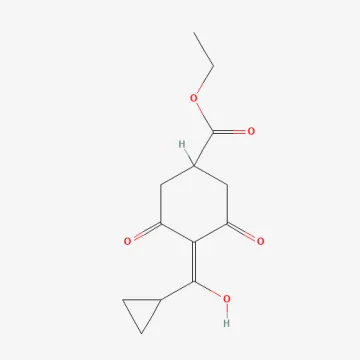
Trinexapac-ethyl
Description
Mode of action
Trinexapac-ethyl belongs to the cyclohexanecarboxylic acid chemical class. It acts as a systemic plant growth regulator and a highly effective plant growth retardant.
The substance functions by inhibiting the 3-beta-hydroxylase enzyme, which is responsible for converting inactive gibberellins into active forms (GA1) that promote cell elongation.
By lowering the concentration of active gibberellins, the compound prevents excessive stem internode elongation, redirecting the plant's energy towards root development and stem thickening.
Unlike many other growth regulators, trinexapac-ethyl is rapidly absorbed by green plant tissues, starting its inhibitory effect within hours of application.
The efficacy of the compound is closely linked to the plant's metabolic activity, ensuring the most significant benefits are achieved during periods of rapid growth and development.
What it targets
The primary use of trinexapac-ethyl is to prevent lodging in cereal crops such as wheat, barley, rye, oats, and triticale by strengthening the structural base of the plant.
Beyond cereals, it is extensively used in professional turf management, including golf courses and sports fields, to suppress turfgrass vertical growth and density.
The compound effectively counteracts stem stretching caused by high nitrogen applications, allowing for intensive crop management without the risk of plant failure.
Using this regulator results in shorter, thicker, and more elastic stems, significantly reducing the risk of lodging due to heavy rain, strong winds, or storm events.
Furthermore, it improves light penetration to the lower leaf canopy, which promotes better ear development and reduces the incidence of certain fungal diseases.
Rates and timing
Application rates for trinexapac-ethyl typically range from 0.2 to 0.6 liters per hectare, depending on the specific crop variety, stage of growth, and target yield.
The critical application window for cereal crops is at the beginning of stem elongation (BBCH 30–32) to ensure the most effective shortening of lower internodes.
For turfgrass, rates and frequency of application are determined by the required cutting height and the intensity of grass maintenance schedules throughout the season.
Uniform distribution of the spray solution over the vegetation is essential, necessitating precise calibration of the application equipment for consistent results.
Applications should be timed during optimal temperature conditions to facilitate maximum uptake and efficacy within the plant's vascular system.
Restrictions
Do not apply the product to crops suffering from stress conditions such as drought, frost, or pest damage, as this may lead to phytotoxicity and crop injury.
Adhering strictly to the application timeline is vital; late applications can cause ear malformation or head sterility, significantly impacting the final harvest.
Avoid tank-mixing with incompatible herbicides without preliminary compatibility testing, as this could lead to reduced efficiency or antagonistic effects on the crop.
Appropriate personal protective equipment (PPE), including gloves and respiratory protection, must be worn during handling and application to ensure safety.
Disposal of unused product and empty containers must strictly follow local environmental regulations and pesticide safety guidelines to prevent environmental contamination.
Status in the European Union
Approved in the EU
- CAS number
- 104273-73-6
- Category (EU)
- PG - Plant growth regulator
- Approved from
- 01.05.2024
- Approval until
- 30.04.2039
- ADI
- 0.32 mg/kg bw/day
- ARfD
- Not appl.
- AOEL
- 0.34 mg/kg bw/day
EU status is for reference only and does not replace national registration in your country.