
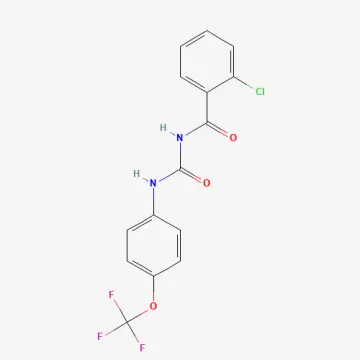
Triflumuron
Description
Mode of action
Teflubenzuron belongs to the benzoylurea chemical class, which functions as a chitin synthesis inhibitor. It is a highly specific active substance designed to regulate the growth and development of insect populations.
The mode of action involves disrupting the formation of chitin in the cuticle of larval stages. When an insect ingests the substance or comes into contact with treated surfaces, it becomes unable to molt properly, which eventually leads to death during the development process.
The substance possesses strong ovicidal properties, preventing the successful development of embryos within eggs laid on treated foliage. It also exhibits transovarial effects, leading to the sterility of eggs laid by adults that have been exposed to the treatment.
Teflubenzuron is characterized by excellent adhesion to plant surfaces and moderate stability against environmental degradation. This allows for a prolonged period of residual control, which is essential for managing pests with staggered emergence periods.
Because its action is non-neurotoxic and specific to the molting process, the knockdown effect is delayed. Farmers should expect that complete population control occurs several days after the application, depending on the stage of the insect development cycle.
What it targets
Teflubenzuron is primarily used to control a wide range of Lepidoptera larvae, including codling moths, leafrollers, and various miners. It is particularly effective against young larvae that are actively feeding on plant tissues.
It is commonly applied in fruit orchards, such as apple and pear plantations, to protect fruits from internal feeders. It is also suitable for use on various vegetable crops and in integrated pest management (IPM) programs.
Its selectivity makes it a preferred choice for sustainable agriculture, as it tends to be less harmful to many beneficial predatory insects and parasitoids compared to broad-spectrum organophosphate or pyrethroid insecticides.
Rates and timing
Timing is the most critical factor for the effective application of teflubenzuron. It should be applied during the peak period of oviposition or just as the first-instar larvae begin to emerge from the eggs.
Application rates vary based on the specific formulation and the crop being treated. Growers must follow the label instructions and monitor pest pressure using pheromone traps or field counts to determine the optimal timing for the first treatment.
Uniform coverage of the crop canopy is essential to ensure that larvae ingest the chemical during their initial feeding phases. Poor coverage will significantly reduce the efficiency of the control program.
Restrictions
Personnel handling teflubenzuron must wear appropriate personal protective equipment (PPE), including chemical-resistant gloves, eye protection, and protective clothing to avoid skin and eye exposure.
Since the product does not provide an immediate kill, it should not be relied upon as a rescue treatment for heavy infestations of adult insects or late-instar larvae that have already caused significant economic damage.
To prevent the development of insect resistance, it is crucial to practice resistance management by rotating teflubenzuron with insecticides that have different modes of action (MOA groups).
The substance is toxic to aquatic invertebrates. Consequently, buffer zones must be maintained near water bodies to prevent runoff, and disposal of product residues must follow local environmental and safety regulations.
Status in the European Union
Not approved in the EU
- CAS number
- 64628-44-0
- Category (EU)
- IN - Insecticide
- Approved from
- 01.04.2011
- Approval until
- 31.03.2021
- ADI
- 0.014 mg/kg bw/day
- ARfD
- Not appl.
- AOEL
- 0.036 mg/kg bw/day
EU status is for reference only and does not replace national registration in your country.