
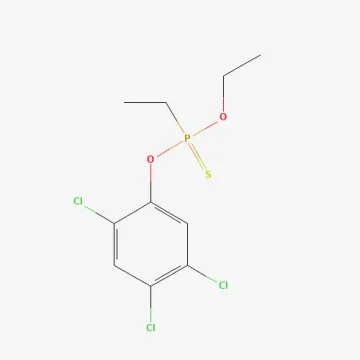
Trichloronat
Description
Mode of action
Trichloronate belongs to the organophosphate (OP) class of chemical compounds and exhibits significant insecticidal activity. Its primary mode of action is the irreversible inhibition of the enzyme acetylcholinesterase within the insect's nervous system.
As a result of enzyme blockage, acetylcholine accumulates in the synaptic gaps, leading to the disruption of nerve impulse transmission. The insect's body enters a state of continuous excitation, followed by paralysis and eventual death.
This substance possesses strong contact and stomach action. It is capable of penetrating the insect cuticle and the digestive tract, ensuring high efficacy against pests that live a hidden or soil-dwelling lifestyle.
As a typical organophosphate, trichloronate is characterized by a degree of volatility and the ability to penetrate soil pores. This allows preparations based on it to effectively target larvae living in the root zone of plants.
A crucial aspect is its toxicological profile. The substance affects the nervous system not only of target organisms but also poses risks to warm-blooded animals, requiring strict adherence to application regulations.
What it targets
The primary use of trichloronate in plant protection is the control of soil-borne pests. It is particularly effective against larvae of scarab beetles, such as May beetles (cockchafers) and wireworms.
The preparation is used to control populations of cutworms, which cause serious damage to the root systems of vegetable and field crops. Eliminating these insects prevents the loss of young seedlings and plant thinning.
Products based on trichloronate are also used to eradicate millipedes and other arthropods that damage potato tubers and root vegetables, reducing their market quality and making them unsuitable for storage.
Furthermore, its spectrum includes some pests that overwinter in the top layer of the soil, allowing for a significant reduction in the pest infestation pressure before the active growing season begins.
The use of this preparation is relevant in intensive farming conditions, where the risk of mass reproduction of soil-dwelling entomofauna is significantly higher due to crop rotation patterns or minimal soil tillage.
Rates and timing
The application timing for trichloronate is most often tied to the period of soil preparation before sowing or planting crops. The product is evenly incorporated into the top soil horizon (at a depth of 5–10 cm) where the concentration of pests is highest.
Application rates depend directly on the level of infestation and the physical-mechanical properties of the soil. In heavy clay soils, the efficacy of OPs may decrease due to the adsorption of active ingredients by soil particles.
During the vegetation period, usage is limited due to the high risk of residues in the final product. Therefore, the main method is preventive application, ensuring root protection during the early growth stages.
When using granular forms, it is essential to ensure correct equipment calibration for precise dosing. Uneven distribution of the substance in the soil leads to the emergence of surviving pest pockets that can quickly restore populations.
Adherence to temperature conditions is mandatory. Organophosphate compounds decompose faster at high temperatures and intense sunlight, so application should preferably take place in the morning or evening hours.
Restrictions
Working with trichloronate requires the use of full personal protective equipment: respirators, gloves, and protective coveralls. OPs are highly toxic when vapors are inhaled or when they come into contact with skin.
It is strictly prohibited to use the product in water protection zones, as the substance poses a serious threat to aquatic ecosystems and fish. Drift of the product onto adjacent unprotected areas must be avoided.
There are strict pre-harvest intervals (PHI) between the last application and the harvest. Consuming produce harvested before the established period is dangerous to human health due to the risk of residual toxins.
Frequent use of the same active ingredient on the same field is not recommended to prevent the development of pest resistance. It is advisable to rotate OPs with insecticides from other chemical classes.
- Mandatory availability of a first-aid kit with antidotes (atropine) at the work site.
- Storage only in original packaging in cool, dry areas.
- Disposal of empty containers must strictly follow hazardous waste management regulations.
- Maintain distance from apiaries, as the product is toxic to bees.
Status in the European Union
Not approved in the EU
- CAS number
- 327-98-0
- Category (EU)
- IN - Insecticide
EU status is for reference only and does not replace national registration in your country.