
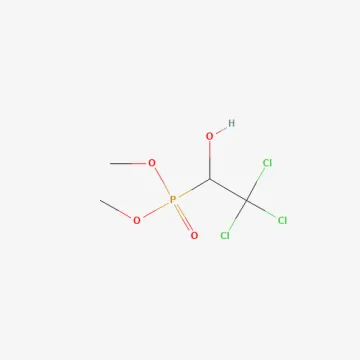
Trichlorfon
Description
Mode of action
Trichlorfon belongs to the organophosphate chemical class and functions as a contact and stomach insecticide. Its primary mode of action is the inhibition of the enzyme acetylcholinesterase within the insect's nervous system.
Within the pest's body, trichlorfon is metabolized into dichlorvos, a more potent compound that disrupts nerve impulse transmission. This leads to paralysis and rapid mortality of the targeted insects.
The substance is absorbed through the insect cuticle and ingested through feeding on treated plant tissues. Because of its rapid penetration, the knockdown effect is typically observed shortly after application.
Biological efficacy is heavily influenced by environmental factors such as temperature, humidity, and the pH of the spray solution. Higher temperatures often accelerate the metabolic activation of the compound.
Since trichlorfon possesses limited systemic properties, thorough coverage of the plant surface is essential to ensure contact with the pests, as the chemical does not move extensively within the plant vascular system.
What it targets
Trichlorfon is used to control a wide variety of chewing and sucking insects. It is particularly effective against the larval stages of Lepidoptera, Coleoptera, and Orthoptera.
Common targets include meadow moths, cutworms, various cabbage white butterflies, fruit moths, and grasshoppers. It is widely employed in field crops and horticultural applications.
Crops commonly treated include cereals, corn, sugar beets, and various vegetable species. It is also utilized in orchards to manage fruit-damaging larvae effectively.
The compound is effective against early larval stages, which are generally more susceptible to organophosphate intervention than mature insects.
- Meadow moth
- Cutworms
- Fruit moths
- Grasshoppers
- Leaf-eating beetles
Rates and timing
Application rates for trichlorfon depend on the specific pest species, crop development stage, and infestation density. Typical application rates range from 0.5 to 2.0 kg of active ingredient per hectare.
The timing of application should be based on pest monitoring data. Ideally, treatments are applied during the mass emergence of younger larval instars to maximize biological impact.
The spray solution must be prepared freshly before application. Proper water volume is critical to ensure uniform distribution of the insecticide across the canopy.
Tank mixing with other pesticides is possible; however, chemical compatibility must be verified beforehand to prevent degradation or phytotoxicity issues.
The number of applications per season is limited to prevent the development of pest resistance and to minimize chemical residues in the environment.
Restrictions
Trichlorfon is highly toxic to bees and other beneficial pollinators. Treatments must not be conducted during the flowering period of crops, and local beekeeping regulations must be strictly observed.
Strict pre-harvest intervals must be followed to ensure that residue levels in the final product comply with safety regulations for human and animal consumption.
Operators must wear appropriate personal protective equipment (PPE), including respirators, chemical-resistant gloves, and protective clothing, to avoid exposure.
Phytotoxicity may occur if the recommended dosage is exceeded, especially if the crop is under stress due to drought, frost, or other unfavorable conditions.
All disposal of pesticide containers and unused spray mixtures must be handled according to local environmental policies to avoid water pollution and soil contamination.
Status in the European Union
Not approved in the EU
- CAS number
- 52-68-6
- Category (EU)
- IN - Insecticide
- ADI
- 0.045 mg/kg bw/day
- ARfD
- 0.1 mg/kg bw
- AOEL
- 0.09 mg/kg bw/day
EU status is for reference only and does not replace national registration in your country.