
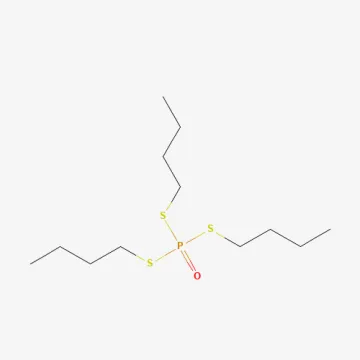
Tribufos
Description
Mode of action
Tribufos is an organophosphorus compound widely used as a professional agricultural defoliant. Its primary function is to induce the shedding of leaves from crops without causing immediate desiccation.
The mechanism of action involves inhibiting specific enzymes and altering the hormonal balance within the plant tissues. This process stimulates the formation of an abscission layer at the base of the leaf petioles, leading to uniform leaf drop.
As a contact-acting substance, Tribufos is absorbed through the leaf surface. It promotes physiological aging and shedding, which is highly efficient for preparing crops for mechanical harvest.
The chemical structure, specifically S-tributyl phosphorotrithioate, ensures stability and consistent performance across various environmental conditions, making it a reliable tool for large-scale farming.
By removing foliage, Tribufos helps synchronize crop maturity and creates an optimal environment for harvesting equipment, thereby reducing potential crop losses and humidity-related quality degradation.
What it targets
The primary crop target for Tribufos is cotton. It is essential in modern cotton production to manage the crop canopy before the harvesting process begins.
Defoliation achieved by Tribufos ensures that harvested cotton lint remains clean and free from leaf trash, which significantly increases the market value of the harvested raw material.
The application is aimed at mature cotton plants during the phase of technical ripeness, ensuring that the bolls are exposed to sunlight and air circulation.
While Tribufos effectively removes the canopy of the target crop, it is not designed to function as a herbicide for broad-spectrum weed control, though it may provide minor suppression of weeds within the cotton rows.
This compound is not classified as an insecticide or fungicide; therefore, it does not provide protection against pests or diseases but is strictly used as a harvest-aid product.
Rates and timing
Application rates for Tribufos are calculated based on the development stage of the cotton crop, specifically the percentage of open bolls, and current climatic conditions.
Field application is conducted using ground-based sprayers or specialized agricultural aircraft equipped with nozzles that ensure thorough coverage of the entire plant canopy.
Proper timing is critical to achieve the desired defoliation effect before the harvest window. Application schedules are strictly governed by regional agricultural recommendations.
Adjusting the rate is necessary according to plant density and environmental temperature. Higher temperatures generally speed up the activity of the chemical, sometimes allowing for lower application rates.
Repeated applications are generally discouraged to maintain the physiological integrity of the crop fibers and to optimize the cost-efficiency of the treatment.
Restrictions
Tribufos must be handled with extreme care due to its chemical activity. Comprehensive safety measures are mandatory for all personnel involved in the mixing and application process.
Preventing drift to neighboring fields is crucial, as the defoliant can cause severe damage or death to non-target crops and sensitive vegetation in adjacent areas.
Storage requires secured, temperature-controlled facilities that are inaccessible to unauthorized persons and prevent leakage into local water systems or soil.
Personal Protective Equipment (PPE), including respiratory protection, chemical-resistant gloves, and eye protection, is required during all stages of handling the product.
- Do not apply near sensitive water bodies or wetlands to prevent aquatic contamination.
- Follow strict re-entry intervals for workers after the product has been applied.
- Dispose of chemical containers in compliance with local environmental regulations.
Status in the European Union
Not approved in the EU
- CAS number
- 78-48-8
- Category (EU)
- PG - Plant growth regulator
EU status is for reference only and does not replace national registration in your country.