
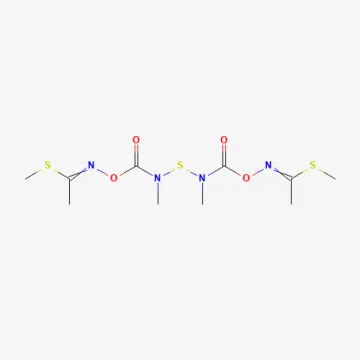
Thiodicarb
Description
Mode of action
Thiodicarb is a potent insecticide belonging to the carbamate chemical class, functioning primarily as a stomach poison with significant contact activity against insects.
The mechanism of action involves the reversible inhibition of the enzyme acetylcholinesterase, which disrupts the transmission of nerve impulses within the insect's nervous system.
Once absorbed by the insect, it causes rapid paralysis and eventually leads to death, making it highly effective at controlling various growth stages of pests.
Due to its chemical stability, Thiodicarb performs consistently across a broad range of temperature conditions, which is crucial for outdoor agricultural applications.
The substance provides a protective residual effect, ensuring that crops remain shielded from infestation for a sufficient period after the initial treatment.
What it targets
Thiodicarb is specifically designed to manage a wide array of pests, particularly those belonging to the Lepidoptera, Coleoptera, and Homoptera orders.
It is widely utilized to control economically significant pests such as armyworms, bollworms, fruit moths, and various leaf-feeding larvae that threaten crop yields.
Key crops protected by this insecticide include cotton, soybeans, maize, vegetables, and various specialty crops that are prone to heavy insect pressure.
The product is often selected in resistance management programs, as it remains highly effective against pest populations that have developed immunity to other chemical classes.
Beyond foliar application, it is used for seed treatments to safeguard germinating seeds and early-stage seedlings against soil-dwelling insects.
Rates and timing
Application rates for Thiodicarb depend on the specific crop and the severity of the infestation, typically ranging from 0.5 to 1.5 kg of active ingredient per hectare.
Timing is critical; treatments should be applied based on regular scouting and when pest populations reach the economic threshold to maximize efficacy.
Proper calibration of spraying equipment is necessary to ensure thorough and uniform coverage of the plant foliage, which is essential for consistent results.
To prevent the selection of resistant insect strains, it is recommended to rotate the use of Thiodicarb with insecticides possessing different modes of action.
Always adhere to the specific pre-harvest interval (PHI) indicated on the product label to ensure the safety of the harvested agricultural commodities.
Restrictions
Thiodicarb is highly toxic to bees and other beneficial pollinators; therefore, spraying during the blooming period is strictly prohibited to protect local ecosystems.
The substance poses health risks to humans and livestock, requiring the strict use of personal protective equipment (PPE) during handling, mixing, and application.
Avoid mixing Thiodicarb with highly alkaline pesticides or fertilizers, as these conditions accelerate the chemical breakdown and reduce the efficacy of the treatment.
Restrict entry into treated areas for the specified re-entry interval (REI) to prevent accidental exposure to chemical residues.
Storage must be maintained in original, tightly sealed containers within a cool, dry, and well-ventilated area, safely away from food, feed, and water sources.
Status in the European Union
Not approved in the EU
- CAS number
- 59669-26-0
- Category (EU)
- IN - Insecticide
EU status is for reference only and does not replace national registration in your country.