
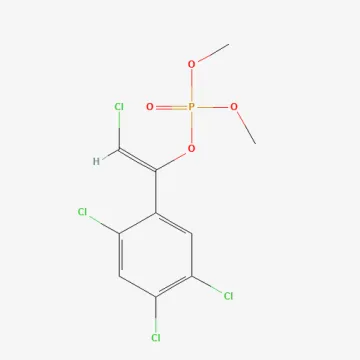
Tetrachlorvinphos
Description
Mode of action
Tetrachlorvinphos belongs to the organophosphate chemical class. It is a broad-spectrum insecticide known for its ability to target insects effectively while maintaining a relatively low toxicity profile for mammals when used according to label instructions.
The mechanism of action involves the irreversible inhibition of the enzyme acetylcholinesterase within the insect's nervous system. This disruption prevents the breakdown of neurotransmitters, causing continuous nerve impulses, paralysis, and death.
The substance acts primarily through contact and ingestion. Once an insect comes into contact with treated surfaces or consumes plant tissue containing the residue, the insecticide is absorbed, leading to rapid knockdown effects.
Tetrachlorvinphos is recognized for its chemical stability, allowing for persistent residual activity on treated surfaces, which is crucial for controlling infestations in storage facilities and livestock housing.
As a non-systemic insecticide, it does not move through the plant's vascular system. Therefore, thorough and uniform application is required to ensure that pests encounter the residue during their feeding or movement.
What it targets
Tetrachlorvinphos is highly effective against a wide range of pests in crop production, specifically targeting various beetles, lepidopteran larvae, and dipteran species that cause economic damage to crops.
In animal health, it is widely utilized to control ectoparasites such as house flies, stable flies, lice, ticks, and mites that infest livestock, poultry, and companion animals.
The chemical is frequently used for structural pest control in warehouses, granaries, and transportation units to protect stored grains and agricultural products from infestation by pantry pests.
In gardening and horticulture, it is applied to combat leaf-eating insects, helping to preserve the foliage and fruit quality during sensitive stages of plant growth.
Veterinary products containing this active ingredient, such as sprays, powders, and pet collars, provide reliable protection for animals against recurring parasite threats.
Rates and timing
Application rates for tetrachlorvinphos are determined based on the target pest, the nature of the surface, and the level of infestation. Precise dosing is required to achieve effective control while adhering to safety regulations.
For agricultural applications, specific concentrations are formulated to protect crops without causing phytotoxicity. Careful calculation of the spray volume per hectare is essential for optimal coverage.
In livestock settings, surface treatment schedules are adjusted based on the life cycle of the parasites to ensure that emerging generations are also controlled, reducing the overall population pressure.
Pre-harvest intervals and withdrawal periods for livestock products must be strictly observed to ensure that residues remain within established safety limits for human consumption.
Environmental conditions, such as temperature and humidity, can influence the degradation rate of the residue; thus, monitoring these factors is key to determining the frequency of re-treatment.
Restrictions
Tetrachlorvinphos is categorized as moderately hazardous, necessitating the use of personal protective equipment, including gloves, respirators, and protective clothing, to prevent dermal or inhalation exposure.
Application must be avoided during the peak activity hours of bees and other pollinators to minimize environmental impact and protect beneficial insect populations near treated fields.
Discharge of the chemical into water bodies, such as rivers, lakes, or drainage systems, must be prevented, as it is highly toxic to aquatic life, particularly fish and invertebrates.
Storage should be confined to secure, well-ventilated areas away from food, feed, and water supplies to prevent cross-contamination and accidental ingestion.
- Always wear appropriate PPE during mixing and application.
- Wash hands and exposed skin thoroughly after handling the product.
- Dispose of containers in accordance with local environmental regulations.
Status in the European Union
Not approved in the EU
- CAS number
- 22248-79-9
- Category (EU)
- IN - Insecticide
EU status is for reference only and does not replace national registration in your country.