
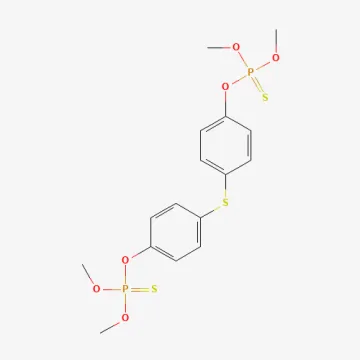
Temephos
Description
Mode of action
Temephos belongs to the organophosphate (OP) chemical class. It acts as a non-systemic contact insecticide and larvicide, demonstrating high efficacy against a broad spectrum of insect species during their larval developmental stages.
The primary mechanism of action is the irreversible inhibition of the acetylcholinesterase enzyme within the insect's nervous system. This causes the accumulation of acetylcholine at the synapses, leading to continuous nerve impulse transmission, paralysis, and eventual death of the organism.
Due to its specific chemical structure, Temephos effectively targets the larval stages of insects, blocking their maturation process. Unlike several other organophosphates, it possesses a level of selective toxicity that allows for use in specific ecological niches.
The compound is characterized by moderate persistence in aquatic environments, making it a highly effective tool for controlling disease vectors that develop in stagnant or slow-moving water bodies.
To achieve maximum biological efficacy, the preparation must be distributed evenly throughout the treatment zone, as its contact action requires direct interaction with the larval cuticle.
What it targets
Temephos is primarily utilized as a larvicide to control the larvae of blood-sucking insects, including mosquitoes, midges, and other dipteran pests that thrive in water bodies devoid of sensitive fish populations.
In agriculture and public health management, the substance is applied to insect breeding sites, which significantly reduces the adult population density in surrounding areas.
The product is also employed for the control of parasites affecting domestic animals, specifically targeting certain species of mites and lice found on the skin of livestock.
Of particular importance is the ability of Temephos to impact insect populations that have developed resistance to pyrethroid-based insecticides, making it an essential tool for rotation programs.
Despite its narrow specialization, the application of Temephos allows for the effective management of pest outbreaks that serve as vectors for transmissible diseases in humans and animals.
Rates and timing
Application rates for Temephos depend on the degree of water contamination, the depth of the water body, and the target insect species. Generally, low concentrations of the active ingredient are used to minimize ecological impact.
Treatment timing is closely linked to the phenological stages of pest development. It is crucial to monitor population dynamics to ensure the product is applied during the most vulnerable larval stage.
In closed systems or when treating surface waters, the frequency of application is strictly regulated to prevent the accumulation of residues in bottom sediments.
During field application, it is important to consider temperature conditions, as intense evaporation or high solar radiation can accelerate the degradation of the active substance.
Periodic measurements of the concentration in water using laboratory analytical methods are recommended to monitor the quality and efficacy of the treatments conducted.
Restrictions
Temephos is toxic to a wide range of aquatic organisms, including crustaceans and certain fish species; therefore, its use in natural water bodies containing fisheries is strictly prohibited or limited.
When handling the product, it is necessary to use personal protective equipment for respiratory, skin, and eye protection, as organophosphates exhibit significant toxicity via dermal absorption.
Extreme caution must be exercised near drinking water sources. Discharging wash water or pesticide residues into open waterways connected to public water supply systems is strictly forbidden.
To prevent the development of resistance in insect populations, it is recommended to rotate Temephos with products from other chemical groups that utilize different mechanisms of neurotoxic action.
- Use only certified product formulations.
- Avoid contamination of food-producing agricultural crops.
- Adhere to strictly enforced health and safety regulations regarding pesticide storage.
Status in the European Union
Not approved in the EU
- CAS number
- 3383-96-8
- Category (EU)
- IN - Insecticide
EU status is for reference only and does not replace national registration in your country.