
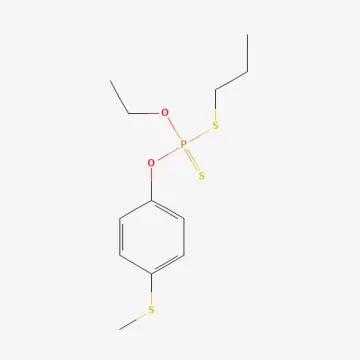
Sulprofos
Description
Mode of action
Sulprofos belongs to the organophosphate class of chemicals. It serves as a potent contact and stomach insecticide, demonstrating significant systemic activity within treated plants.
The primary mechanism of action involves the inhibition of the enzyme acetylcholinesterase, which disrupts the transmission of nerve impulses, leading to paralysis and eventual death of the pest.
The substance is known for its high initial knockdown effect, which allows for rapid reduction of pest population densities immediately after application.
Due to its systemic properties, the compound is absorbed into plant tissues, providing prolonged protection for emerging plant growth against feeding pests.
As an organophosphate, it remains effective in various environmental conditions, making it a reliable component in integrated pest management strategies.
What it targets
Sulprofos is designed to manage a diverse range of agricultural pests, including species from the orders Lepidoptera, Coleoptera, and Homoptera.
It is particularly effective against highly damaging pests such as bollworms, various aphid species, leafhoppers, and leaf-mining moths.
The insecticide is widely utilized on crops requiring intensive protection, including cotton, various vegetables, and specific orchard crops.
It proves valuable for controlling late-instar larvae that often exhibit resistance to other common insecticide classes like pyrethroids.
- Highly effective against both adult and larval life stages
- Targeting of concealed pests within leaf tissues
- Rapid suppression of high-density pest infestations
Rates and timing
Application rates for sulprofos are determined based on the specific crop type, the pest pressure observed, and the regional agricultural guidelines.
Applications should be timed to coincide with the most vulnerable stages of the pest lifecycle to achieve the highest possible mortality rates.
Uniform distribution of the spray solution over the crop canopy is essential to ensure adequate coverage and consistent biological efficacy.
Adherence to recommended application intervals is vital to manage the risk of pest resistance development within the cropping cycle.
Compatibility testing is highly recommended when tank-mixing with other agrochemicals to prevent potential chemical degradation or crop phytotoxicity.
Restrictions
Sulprofos is categorized as highly toxic to honeybees and other beneficial insects; therefore, application during the flowering stage is strictly prohibited.
Compliance with mandatory pre-harvest intervals is essential to ensure that residues on food crops remain within safe limits for human consumption.
Personal Protective Equipment (PPE) including respiratory protection and chemical-resistant clothing must be worn by operators during mixing and application.
Spray drift must be strictly managed to prevent contamination of neighboring non-target crops, waterways, and livestock grazing areas.
Secure storage in dedicated facilities is required, ensuring that the chemical is kept away from unauthorized persons and environmental run-off pathways.
Status in the European Union
Not approved in the EU
- CAS number
- 35400-43-2
- Category (EU)
- IN - Insecticide
EU status is for reference only and does not replace national registration in your country.