
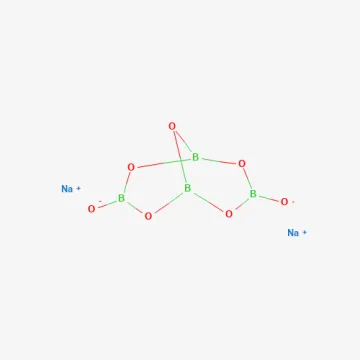
Sodium tetraborate
Description
Mode of action
Sodium tetraborate belongs to the group of inorganic boron compounds that exhibit significant biological activity against various pests. Its action is based on disrupting metabolic processes in the target organisms.
Upon ingestion by an insect, the substance causes systemic intoxication, attacking the nervous system and destroying cellular structures. This results in paralysis and subsequent death of the pest within a few days after contact.
The preparation has a prolonged effect, allowing for the control of population numbers over an extended period. It is not a contact poison in the traditional sense, but acts primarily as a stomach toxin.
Unlike many modern pesticides, this compound is virtually immune to degradation by sunlight, maintaining activity in dry habitats where pests thrive.
The mechanism of action also includes the disruption of enzymatic activity, which makes normal food digestion impossible for insects, leading to their starvation and death by intoxication simultaneously.
What it targets
Sodium tetraborate is primarily used as an insecticidal agent aimed at controlling crawling insects, specifically ants, cockroaches, and silverfish.
In agronomic practice, the compound can be applied for the disinfection of warehouses, storage facilities, and agricultural areas where high concentrations of pests are observed.
The substance is effective against many types of domestic and agricultural pests that lead a hidden lifestyle and move across surfaces treated with the preparation.
It demonstrates high efficiency in bait formulations, where insects are actively attracted, allowing for the use of minimal doses of the substance to treat large areas.
Additionally, boron compounds in low concentrations are used as micronutrient fertilizers to prevent boron deficiency in crops, which indirectly increases their resistance to pest attacks.
Rates and timing
The application of sodium tetraborate requires strict dosing depending on the target object and the method of application, whether it is an aqueous solution or a dry bait.
Typically, a 5–10% concentration of the active ingredient, mixed with a food-based attractant, is used as a base for baits to lure insects.
When treating surfaces by spraying, aqueous solutions with a concentration of 2% to 5% are used, which are applied locally in areas where pests congregate.
The timing of treatments depends on the seasonal activity of the insects; application is most effective during periods of their peak reproduction and migration.
It is important to note that when used as a micronutrient fertilizer, application rates differ fundamentally and require foliar spraying during active crop growth phases.
Restrictions
Sodium tetraborate is a substance that requires caution during use, as high doses can exhibit phytotoxicity to agricultural crops.
It is forbidden to use the preparation near water bodies and drinking water sources due to the risk of boron compound accumulation in soil and groundwater.
Direct contact of the agent with skin and mucous membranes must be avoided; the use of personal protective equipment is mandatory when handling.
Storage of the preparation must be carried out in a closed container, in a place inaccessible to children and pets, and away from food products or feed.
When used in fields, specified waiting periods must be observed to prevent residual amounts of boron from entering commodity products during harvest.
Status in the European Union
Not approved in the EU
- Category (EU)
- IN - Insecticide
EU status is for reference only and does not replace national registration in your country.