
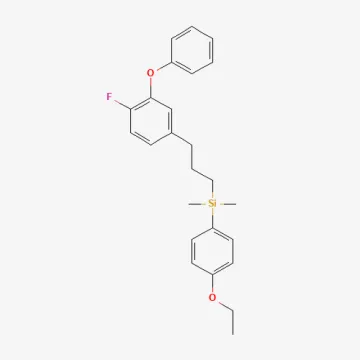
Silafluofen
Description
Mode of action
Silafluofen is a highly effective insecticidal active ingredient belonging to the class of fluorinated organosilicon compounds. Its unique molecular structure allows for efficient penetration through the insect cuticle, ensuring rapid action on their physiological systems.
The mode of action is based on the disruption of nerve impulse transmission within the insect organism. The substance acts on the sodium channels of nerve cell membranes, leading to excessive excitation, paralysis, and subsequent death of the pest within a short period.
The compound exhibits both contact and stomach action. Due to the lipophilic properties of its molecules, silafluofen adheres well to the leaf surface, providing prolonged residual activity even under changing weather conditions.
Silafluofen demonstrates significant insecticidal activity against a broad spectrum of phytophagous pests. Formulations based on this active ingredient are frequently used as components in tank mixes to achieve synergistic effects with other pesticides.
An important feature of this compound is its ability to control pest populations that have developed resistance to classical organophosphate or pyrethroid insecticides. This makes it a valuable tool in anti-resistance crop protection strategies.
What it targets
The primary use of silafluofen is the control of a pest complex on field and vegetable crops. It is effective against Lepidoptera, Coleoptera, and certain Hemiptera species that damage the vegetative mass of plants.
The preparation is successfully applied for the protection of cereal crops against grain beetles, cereal leaf beetles, and cereal flies. It also shows high performance in rapeseed fields for controlling rapeseed beetles and cruciferous flea beetles.
In vegetable growing, silafluofen is used to combat cutworm larvae, moths, and white butterflies. The active ingredient effectively destroys both young-instar larvae and adults, preventing damage to the reproductive organs of the plants.
Application is recommended when economic damage thresholds are exceeded. It helps minimize crop losses from concealed pests due to its ability to reach hard-to-access parts of the plants.
Silafluofen is also actively used in orchards and vineyards against leafrollers and other pests that damage fruit buds and leaf apparatus, contributing to the preservation of product quality and commercial appearance.
Rates and timing
Application rates of silafluofen vary depending on the crop type, pest infestation level, and climatic conditions. The preparation is usually applied via fine-droplet spraying of crops during the period of active pest vegetation.
The optimal timing for application coincides with the pest hatching phase. It is essential to perform treatments before pests cause significant damage, which requires regular field monitoring using traps.
When preparing the spray solution, it is necessary to ensure uniform coverage of the entire leaf surface area. The use of high-quality adjuvants is recommended to improve adhesion and penetration of the active ingredient into plant tissues.
Pre-harvest intervals are defined by specific product regulations and generally range from 20 to 30 days. This time is required for the complete breakdown of the active ingredient to safe levels in fruits and grains.
The interval between repeated applications should be at least 10–14 days, if provided for by the protection scheme. Subsequent applications should follow anti-resistance programs, avoiding the use of products with similar modes of action.
Restrictions
Silafluofen is a moderately toxic substance for warm-blooded animals, so strict adherence to safety precautions is required during handling. The use of personal protective equipment for skin, respiratory organs, and eyes is mandatory.
The preparation poses a danger to bees and other beneficial insect entomophages. It is prohibited to apply the treatment during the flowering of honey-producing crops or during periods of high activity of flying insects to prevent mass mortality of pollinators.
Discharging residue of the working solution and washing water near water bodies, wells, and water intake points is strictly prohibited. Silafluofen can exhibit toxicity to aquatic organisms, requiring strict adherence to sanitary zones around water bodies.
Storage of the pesticide must be carried out in specialized warehouses inaccessible to children and pets. The storage temperature must comply with the manufacturer's requirements to ensure the stability of the chemical formula.
Before application, it is necessary to verify the compatibility of silafluofen with other pesticides or fertilizers in a tank mix. If signs of precipitation or color change in the mixture appear, the use of such a combination is prohibited.
Status in the European Union
Not approved in the EU
- CAS number
- 105024-66-6
EU status is for reference only and does not replace national registration in your country.