
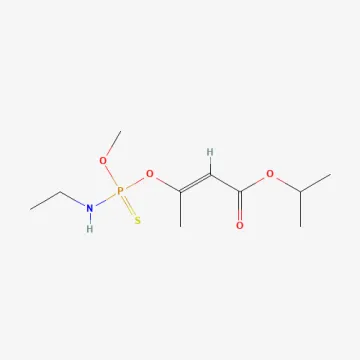
Propetamphos
Description
Mode of action
Propetamphos is an organophosphate compound that acts as a potent insecticide, primarily targeting the nervous system of pests.
Its primary mechanism of action involves the inhibition of the enzyme acetylcholinesterase, which is crucial for nerve impulse transmission in insects.
By blocking this enzyme, the compound causes an accumulation of acetylcholine, leading to continuous nerve firing, paralysis, and rapid mortality.
The substance possesses both contact and stomach poison properties, allowing it to penetrate through the insect's cuticle efficiently.
It is characterized by good residual activity on treated surfaces, ensuring that the control effect persists for a necessary period after the initial application.
What it targets
Propetamphos is widely utilized to control a variety of crawling and flying insects that pose threats to stored products and public health.
Key targets for this insecticide include:
- Cockroaches (German, American, etc.)
- Ants and various household pests
- Stored-product beetles and weevils
- Houseflies and mosquitoes
- Fleas and bed bugs
It is extensively used in professional pest control for storage facilities, warehouses, grain elevators, and livestock barns.
The substance is favored for its ability to clear heavy infestations in industrial and commercial environments effectively.
Rates and timing
Application rates for propetamphos are strictly determined by the formulation type, such as emulsifiable concentrates or ready-to-use aerosols.
For surface treatments, the preparation must be diluted according to precise labeling instructions to ensure efficacy without excessive residue.
The timing of applications should be synchronized with the life cycle of the targeted pests to maximize the impact on larvae and adult stages.
In high-infestation scenarios, multiple applications at specified intervals may be required to maintain total control of the population.
Always verify the specific dosage per square meter recommended for the surface type to avoid potential surface damage or insufficient coverage.
Restrictions
Handling propetamphos requires rigorous safety protocols, including the use of protective gloves, goggles, and respiratory equipment to avoid exposure.
Applications must not occur in the presence of unprotected people or pets, and areas should be vacated during the treatment and drying process.
Adequate ventilation after application is mandatory before re-occupying the treated premises to prevent inhalation of chemical vapors.
Propetamphos should not be applied near food preparation areas or water sources, and all surface residues must be cleaned according to guidelines.
The chemical should be kept in its original, sealed container in a cool, dark location away from heat sources and incompatible substances.
Status in the European Union
Not approved in the EU
- CAS number
- 31218-83-4
- Category (EU)
- IN - Insecticide
EU status is for reference only and does not replace national registration in your country.