
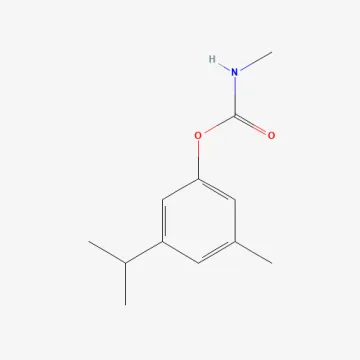
Promecarb
Description
Mode of action
Promecarb belongs to the carbamate chemical class and acts as a highly effective insecticidal active ingredient. Its primary mechanism of action involves the inhibition of the enzyme acetylcholinesterase within the pest's nervous system.
Once the product enters the insect's body, it disrupts the transmission of nerve impulses at the synapses. This results in continuous nervous system excitation, leading to paralysis and rapid death of the organism.
The substance possesses both contact and stomach action, which ensures a fast knockdown effect even at low doses. Activity is observed almost immediately after the pest comes into contact with the treated surface or consumes plant parts.
A key feature of promecarb is its ability to penetrate the insect cuticle rapidly, making it indispensable for controlling species with thick chitinous layers. It is well-regarded for its immediate impact on insect populations.
In field conditions, the substance exhibits moderate persistence, allowing it to maintain a protective barrier on leaf surfaces for a period, which helps control subsequent waves of pest infestation.
What it targets
Promecarb is primarily used to control a wide range of chewing and sucking insects that pose a threat to commercial crop production.
It demonstrates high efficacy against various species of beetles, lepidopteran larvae, and specific pests of vegetable crops.
The product is particularly effective against pest populations that have developed resistance to organophosphate pesticides, due to its distinct mode of action on the nervous system.
In agronomic practice, it is utilized to protect cereals, vegetables, and certain fruit crops from a complex of cryptic and surface-feeding insects.
The main target spectrum includes the following groups of pests:
- Various species of cutworms and leaf-eating caterpillars.
- Phyllophagous insects damaging the foliage of crops.
- Pests damaging the root system and the root zone of young seedlings.
Rates and timing
Application rates for promecarb are determined based on the phytosanitary status of the field and the specific pest species present. It is crucial to follow the manufacturer's label strictly for each specific formulation.
Application is recommended during the peak period of larval emergence or adult activity, when the pest population density exceeds the economic injury level.
The number of applications per season is strictly regulated to prevent the accumulation of residues in the harvest and to mitigate the risk of resistance development.
When preparing the spray solution, use clean water and ensure uniform coverage of the foliage to maximize the effectiveness against the target pest population.
The optimal time for application is during the early morning or late evening when wind speeds are low and solar radiation is minimal, which helps improve the stability of the active ingredient.
Restrictions
Handling promecarb requires strict adherence to safety protocols. The substance is toxic to warm-blooded animals, and all handling procedures must involve the use of personal protective equipment.
Applications during the flowering of honey plants are strictly prohibited due to the high risk to bees and other beneficial entomofauna, requiring prior notification to local beekeepers.
It is mandatory to observe the pre-harvest interval (PHI) between the final application and harvesting, which is a critical requirement for food safety.
Storage must be conducted in specialized warehouses that prevent unauthorized access and protect the environment from potential leakage into water sources or soil.
When tank-mixing with other pesticides, conduct a physical-chemical compatibility test beforehand to prevent the formation of precipitates or loss of biological efficacy.
Status in the European Union
Not approved in the EU
- CAS number
- 2631-37-0
- Category (EU)
- IN - Insecticide
EU status is for reference only and does not replace national registration in your country.