
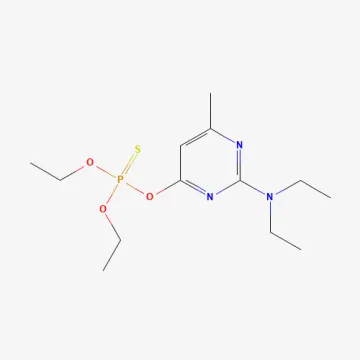
Pirimiphos-ethyl
Description
Mode of action
Pirimiphos-ethyl belongs to the organophosphate class of chemicals. It functions as a potent, broad-spectrum insecticide and acaricide with contact and stomach action.
The primary mechanism of action involves the inhibition of acetylcholinesterase, an enzyme essential for nerve impulse transmission in insects and mites, causing paralysis and death.
This compound possesses significant fumigant properties, allowing it to penetrate cracks, crevices, and dense foliage where pests often hide.
It exhibits translaminar activity, which enables the chemical to move from the leaf surface into the plant tissues, offering protection even to the underside of treated leaves.
The substance is known for its rapid knockdown effect, providing immediate control of infestations in field crops and storage facilities alike.
What it targets
Pirimiphos-ethyl is highly effective against a wide range of agricultural pests including beetles, aphids, thrips, and various species of mites.
It is widely utilized in vegetable, fruit, and cereal crop production to manage populations of chewing and sucking insects.
A major application is the protection of stored grain, where it effectively eliminates storage pests such as weevils, flour beetles, and moths.
The chemical acts on both adult insects and larvae, ensuring comprehensive control during different stages of the pest lifecycle.
It is specifically valued in storage environments for its ability to disinfest empty warehouses and bulk grain silos efficiently.
Rates and timing
Application rates depend on the target crop, the severity of the infestation, and whether the treatment is applied to standing crops or warehouse surfaces.
For field crops, the standard application rate typically ranges between 0.5 and 1.5 liters per hectare, depending on the formulation concentration.
In warehouse treatments, dosages are calculated based on surface area (per square meter) or total volume (per cubic meter) of the storage facility.
Optimal efficacy is achieved when applications are performed at air temperatures between +15°C and +25°C.
Pre-harvest intervals (PHI) must be strictly observed, generally ranging from 20 to 40 days to ensure that residue levels are within safe regulatory limits.
Restrictions
Pirimiphos-ethyl is toxic to bees; therefore, applications must be avoided during the flowering period or when flowering weeds are present in the field.
Users must wear appropriate personal protective equipment (PPE) during handling and application to prevent dermal contact and inhalation of vapors.
Mixing this substance with alkaline-reactive chemicals is strictly discouraged, as it can cause rapid hydrolysis and degradation of the active ingredient.
Care must be taken to prevent environmental contamination, particularly avoiding runoff into water bodies or proximity to livestock feed storage.
Compliance with Maximum Residue Limits (MRLs) for treated crops is mandatory to ensure food safety standards are maintained for consumers.
Status in the European Union
Not approved in the EU
- CAS number
- 23505-41-1
- Category (EU)
- IN - Insecticide
EU status is for reference only and does not replace national registration in your country.