
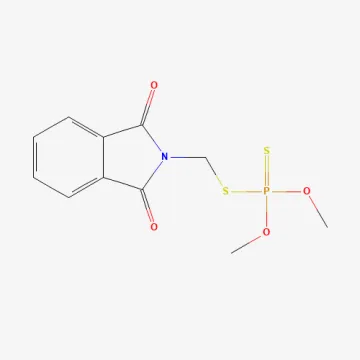
Phosmet
Description
Mode of action
Phosmet belongs to the organophosphate (OP) chemical class and acts as a broad-spectrum contact and stomach insecticide.
The mode of action involves the inhibition of the acetylcholinesterase enzyme in the insect's nervous system. This causes an accumulation of acetylcholine in the synapses, leading to continuous nerve impulse transmission, paralysis, and eventual death of the pest.
The active ingredient penetrates quickly through the insect's cuticle or is ingested, providing high efficacy even under moderate temperature conditions.
Phosmet possesses significant residual activity on treated surfaces, which allows for long-term control of pest populations after application.
As it is not a systemic compound, Phosmet requires thorough coverage of all plant parts to ensure optimal contact with target pests.
What it targets
This substance effectively controls a complex of chewing and sucking pests, including Lepidoptera (caterpillars), Coleoptera (beetles), and Hemiptera.
Primary targets include codling moths, leafrollers, weevils, leafminers, and various aphid species affecting perennial crops.
Phosmet is widely used in orchards to manage pests on pome and stone fruits, as well as in citrus groves and vineyards.
The product also demonstrates efficacy against certain soil-dwelling pests and various mite species by disrupting their development cycle.
- Codling moths (Cydia pomonella)
- Leafrollers
- Weevils
- Plum and cherry fruit flies
- Leafminers
Rates and timing
Application rates for Phosmet depend on the crop type, planting density, and specific pest pressure, ranging from moderate to high concentrations.
Treatments should be timed according to peak insect activity and the economic threshold (ET) established for the specific crop.
In commercial orchards, achieving complete canopy coverage is essential, as the insecticide's effectiveness is heavily reliant on uniform surface distribution.
Intervals between applications should be at least 14 to 21 days to minimize residue buildup in fruit and to reduce the potential for pest resistance development.
Pre-harvest intervals (PHI) are strictly regulated and typically range from 20 to 45 days, depending on the crop variety and local climatic conditions.
Restrictions
Phosmet is highly toxic to bees and other pollinators, making any application during the bloom period strictly prohibited.
Users must observe buffer zones and restrict bee activity for several days following the application to prevent colony damage.
It is not recommended to rotate Phosmet with other organophosphate insecticides to prevent the rapid development of resistance in pest populations.
Handling this substance requires strict adherence to safety protocols, including the use of respiratory protection, goggles, and full-body protective clothing.
The product is hazardous to aquatic life; therefore, drift onto water bodies and riparian areas must be strictly avoided during spray operations.
Status in the European Union
Not approved in the EU
- CAS number
- 732-11-6
- Category (EU)
- IN - Insecticide
- Approved from
- 01.10.2007
- Approval until
- 01.02.2022
- ADI
- 0.001 mg/kg bw/day
- ARfD
- 0.001 mg/kg bw
- AOEL
- 0.001 mg/kg bw/day
EU status is for reference only and does not replace national registration in your country.