
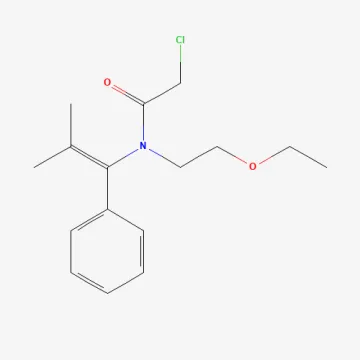
Pethoxamid
Description
Mode of action
Pethoxamid belongs to the chloroacetamide chemical class. It is a highly effective active ingredient that exhibits systemic activity against a wide range of annual grasses and certain broad-leaved weeds.
The primary mode of action is the inhibition of cell division in germinating weeds. The substance blocks the synthesis of very long-chain fatty acids, which leads to the cessation of growth in meristematic tissues.
Unlike many soil herbicides, pethoxamid affects weeds at the moment of germination. Upon entering the seed through the coleoptile or hypocotyl, the active component moves rapidly to the growth points, causing the seedling to die before or immediately after emergence.
The product provides strong soil-based activity, creating a protective layer in the topsoil. This allows for effective control of new weed flushes that may germinate for several weeks after the initial application.
Pethoxamid is characterized by high selectivity for crops when used according to regulations. The metabolic processes of crops allow them to rapidly neutralize the active ingredient, ensuring yields remain unaffected.
What it targets
Pethoxamid is primarily used for the control of annual grass weeds. The list of sensitive species includes barnyard grass, various foxtail species, silky bentgrass, and black-grass.
The herbicide also suppresses the development of certain difficult-to-control broad-leaved weeds, such as redroot pigweed, black nightshade, chamomile species, and cleavers. However, efficacy against broad-leaved weeds can depend on weather conditions.
It is widely applied in corn, rapeseed (winter and spring), sunflower, and soybean crops. This makes it a versatile tool for intensive field crop cultivation technologies.
The product is most effective when weeds are at the germination stage. Mature, well-developed weeds show little response to treatment, which is why applying the product before weed emergence is critical.
Using pethoxamid in tank mixes with other herbicides significantly broadens the spectrum of controlled broad-leaved weeds, ensuring clean fields during the critical growth stages of the crop.
Rates and timing
The application rate of pethoxamid varies depending on soil type and weed pressure. Lower dosages are used on light soils, while heavier loams or high-humus soils require higher rates for maximum efficacy.
The optimal time for application is pre-planting (with incorporation) or post-planting but before the emergence of both the crop and weeds. Pre-emergence application provides the best protection for the crop.
An important condition for high efficacy is the presence of minimum soil moisture. Subsequent rainfall or irrigation helps wash the herbicide into the weed germination zone, which activates its biological effect.
When using tank mixes, it is necessary to conduct a physical-chemical compatibility test. Combining with other products helps optimize costs and increases overall protection performance.
- Ensure uniform distribution of the working solution over the field surface.
- Avoid spraying during high winds to prevent drift.
- Temperature conditions do not have a critical impact on soil screen efficacy, but they do influence the rate of crop metabolism.
Restrictions
The main limitation is dependence on soil moisture. Under extreme drought conditions, pethoxamid efficacy may decrease as the active ingredient fails to reach the root zone of germinating weeds.
Application on soils with very high organic matter (peat soils) is not recommended, as they strongly adsorb the herbicide, significantly reducing its available concentration in the soil solution.
Crop rotation should be considered when planning weed control. Although pethoxamid decomposes relatively quickly, unfavorable conditions (low temperatures, lack of rainfall) can lead to residual effects on sensitive follow-up crops.
Application on crops under stress (due to frost, waterlogging, or pest damage) may lead to temporary growth suppression, although the crop usually recovers quickly.
Safety precautions include the use of personal protective equipment for operators. The product is toxic to aquatic life, so avoid contamination of water bodies and sewage systems with leftover working solutions.
Status in the European Union
Approved in the EU
- CAS number
- 106700-29-2
- Approved from
- 01.12.2018
- Approval until
- 30.11.2033
- ADI
- 0.01 mg/kg bw/day
- ARfD
- 0.08 mg/kg bw
- AOEL
- 0.02 mg/kg bw/day
EU status is for reference only and does not replace national registration in your country.