
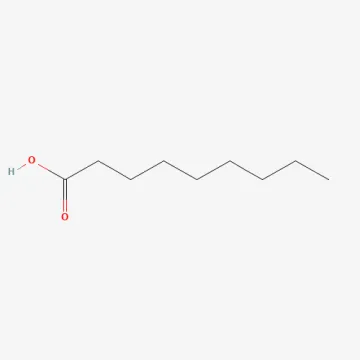
Pelargonic acid
Description
Mode of action
Pelargonic acid (nonanoic acid) belongs to the class of fatty carboxylic acids. It acts as a non-selective contact herbicide, meaning it possesses no systemic properties and does not translocate within plant tissues.
The mechanism of action relies on the destruction of the epicuticular wax layer and damage to plant cell membranes. Upon contact, the integrity of cell walls is compromised, leading to rapid moisture loss and instant dehydration of green plant tissues.
The visual effect is extremely rapid: yellowing and necrosis of the green parts of the plant, where the working solution has made contact, can be observed within a few hours.
A key feature of this substance is its lack of soil activity. It degrades rapidly in the soil due to microbial activity, posing no threat to subsequent crops in a rotation cycle.
The product does not accumulate in roots; therefore, perennial weeds with well-developed root systems may recover if the aerial parts are not fully destroyed or if a repeat application is not performed.
What it targets
Pelargonic acid is used to control a wide range of annual broad-leaved and grass weeds, and also serves as a desiccant for pre-harvest drying of crops.
It is effective against young weeds at early development stages when the leaf surface area is maximized for contact with the active ingredient.
It is utilized for clearing weed growth in orchards, vineyards, and industrial sites or roadsides where non-selective vegetation control is required.
The substance is applied in vegetable farming for localized weed control between rows, provided that cultural plants are protected from direct spray contact.
As a desiccant, it is used on various crops to ensure uniform ripening and to facilitate mechanical harvesting by promoting rapid drying of vegetative mass.
Rates and timing
Application rates vary depending on the weed growth stage and the objective of the treatment. High concentrations of the working solution are typically required to ensure thorough coverage of the target plants.
Optimal timing for spraying is during dry, sunny weather with temperatures above 15-20 degrees Celsius, as intense sunlight accelerates membrane degradation processes.
For desiccation purposes, timing is determined by the physiological maturity phase of the crop to avoid yield loss or a decrease in seed quality.
It is recommended to use sufficient water volume to ensure thorough wetting of the leaf surface until the point of runoff.
It is important to note that rainfall shortly after application may reduce efficacy, as the active ingredient requires a short contact time to be effective.
Restrictions
Avoid spray drift onto cultural plants, as pelargonic acid causes burns to any green tissue it contacts.
The substance has a strong, characteristic odor, necessitating strict adherence to safety precautions when preparing the working solution in enclosed areas.
Use of personal protective equipment for skin and respiratory tract protection is mandatory when handling the product to prevent irritation of mucous membranes.
Store products containing pelargonic acid in a place inaccessible to children and away from food and animal feed.
Mixing with systemic herbicides is not recommended if the treatment objectives and application windows for the two products differ significantly in biological activity.
Status in the European Union
Approved in the EU
- CAS number
- 112-05-0
- Category (EU)
- PG - Plant growth regulator
- Approved from
- 01.09.2009
- Approval until
- 01.12.2026
- ADI
- Not appl.
- ARfD
- Not appl.
- AOEL
- Not appl.
EU status is for reference only and does not replace national registration in your country.