
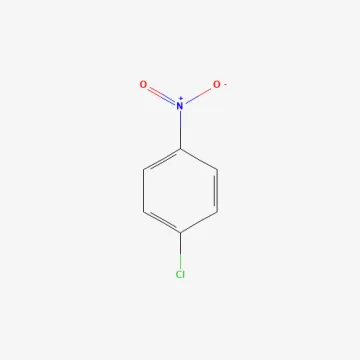
p-Chloronitrobenzene
Description
Mode of action
p-Chloronitrobenzene (1-chloro-4-nitrobenzene) belongs to the class of aromatic nitro compounds. Within the agricultural chemical industry, it does not function as a standalone pesticide for field application but serves as a fundamental building block and intermediate in the synthesis of various active ingredients for plant protection products.
The reactivity of p-chloronitrobenzene is dictated by the chlorine atom on the benzene ring, which can be easily substituted through nucleophilic reaction processes to build more complex and biologically active molecules tailored for specific agricultural tasks.
This molecule is instrumental in creating structures that effectively interfere with weed metabolic pathways, making it a critical component in the production chain of selective herbicides and other specialized crop protection formulations.
The transformation process during pesticide manufacturing ensures that this intermediate is converted into a stable and functional product. High-level chemical processing is required to ensure that no reactive intermediates remain in the final commercial pesticide formula.
From an agronomic perspective, the availability of high-purity derivatives derived from this compound ensures that final products maintain high efficacy, consistency, and predictable behavior when applied to various crops.
Restrictions
p-Chloronitrobenzene is recognized as a hazardous chemical with significant toxicity profile. It poses severe risks to human health via inhalation, skin contact, or ingestion, and requires stringent safety protocols during all industrial handling stages.
Industrial facilities utilizing this chemical must implement closed-loop systems to prevent any environmental release. Due to its persistence and potential toxicity to aquatic life, strict waste management and water treatment protocols are mandatory.
Workers involved in the chemical synthesis process are required to adhere to rigorous safety standards, including the use of certified personal protective equipment and regular health monitoring to prevent systemic exposure.
Storage of the bulk chemical requires dedicated facilities with fire prevention and spill containment measures, as it is sensitive to high temperatures and can release toxic fumes if involved in a fire event.
The final agricultural products derived from this intermediate are tested for safety before market release, and users must follow the label instructions for field application to minimize environmental impact and protect non-target organisms.
Status in the European Union
Not approved in the EU
- CAS number
- 100-00-5
- Category (EU)
- IN - Insecticide
EU status is for reference only and does not replace national registration in your country.