
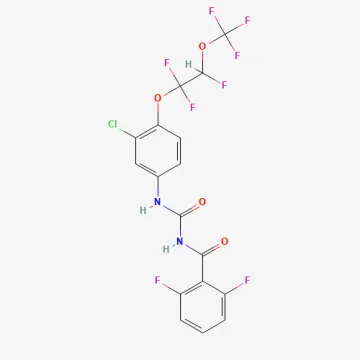
Novaluron
Description
Mode of action
Novaluron belongs to the benzoylphenylurea class and acts as a potent insect growth regulator (IGR). It is highly effective in disrupting the developmental cycle of various insect species by interfering with their physiological processes.
The core mechanism of action is the inhibition of chitin synthesis. Chitin is a crucial structural component of the insect exoskeleton; by preventing its formation, the insect cannot successfully undergo molting, leading to death.
The substance also exhibits strong ovicidal properties, meaning it kills eggs or prevents the larvae from successfully hatching. This helps to break the breeding cycle of pests significantly reducing their population density.
Novaluron possesses translaminar properties, allowing it to move across leaf tissues. This characteristic ensures that even pests feeding on the underside of leaves are exposed to the active ingredient.
Due to its high chemical stability, Novaluron provides long-lasting residual control, which is essential for protecting crops during critical stages of their development and preventing new outbreaks.
What it targets
Novaluron is primarily used to control a wide range of Lepidoptera larvae, including various moth species, loopers, and armyworms that cause significant economic damage to agricultural crops.
It is widely utilized in potato cultivation to manage Colorado potato beetle populations, providing an effective solution where other chemicals have lost efficacy due to resistance.
The insecticide is effective against a variety of pests in fruit orchards, vegetable crops, cotton, and soybean, particularly targeting leaf-eating insects that are difficult to reach with standard contact poisons.
It is also employed against specific Diptera and Coleoptera species, proving to be a versatile tool for integrated pest management programs (IPM) due to its selective action.
By preventing damage to reproductive parts of plants, Novaluron ensures higher yields and better quality of agricultural produce, especially in crops susceptible to internal fruit feeders.
Rates and timing
The application rate for Novaluron is typically determined by the target pest species and the crop density. Farmers usually apply between 50 to 100 grams of the active ingredient per hectare.
Optimal timing for application is during the early larval development stages. Applying the insecticide when the first eggs hatch ensures maximum exposure and prevents subsequent tissue damage.
It is recommended to use surfactants with Novaluron to enhance its adherence to the plant surface and increase penetration into the cuticle, especially for crops with waxy or hairy leaves.
Depending on the pest pressure, a second application may be required after 10–14 days. Consistent monitoring of fields is essential to determine the exact timing for repeat treatments.
Ensuring complete and uniform coverage is critical for the product's effectiveness. Modern spraying equipment with proper calibration is required to achieve the desired results across the field.
Restrictions
Novaluron does not provide an immediate knock-down effect, as it takes time for the insects to reach the next molting stage. Patience is required when evaluating the field's response to treatment.
To mitigate the risk of resistance development, Novaluron should be used in rotation with insecticides belonging to different chemical classes with alternative modes of action.
Users must follow standard safety protocols when handling the substance, including the use of protective gloves, masks, and eye protection to avoid accidental exposure or irritation.
Application should be avoided during periods of high wind to prevent spray drift and during conditions that may lead to environmental contamination or impact on non-target species.
Storage of the chemical must be in a cool, dry, and well-ventilated area, away from food, feed, and children. Disposal of packaging should comply with local environmental regulations.
Status in the European Union
Not approved in the EU
- CAS number
- 116714-46-6
- Category (EU)
- IN - Insecticide
EU status is for reference only and does not replace national registration in your country.