
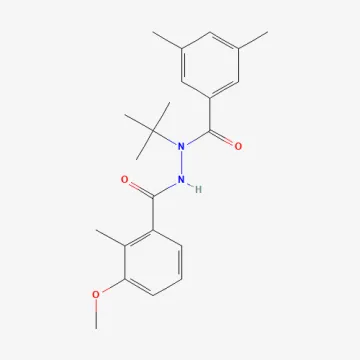
Methoxyfenozide
Description
Mode of action
Methoxyfenozide belongs to the diacylhydrazine chemical class and functions as a highly selective insect growth regulator. The substance mimics the action of the natural molting hormone, ecdysone, by binding to insect receptors.
As a result of this exposure, pest larvae initiate the molting process prematurely. Since this process occurs pathologically fast and cannot be completed physiologically, the insect dies from exhaustion and moisture loss.
This mechanism of action is highly selective, ensuring minimal impact on non-target organisms. Methoxyfenozide has negligible effects on beneficial insects, entomophages, and predatory mites, making it an excellent component for Integrated Pest Management (IPM) programs.
The compound exhibits strong stomach activity and mild contact activity. Maximum efficacy is achieved when the active ingredient is ingested by the pest through the treated plant tissue.
It is characterized by excellent rainfastness and a long residual effect. This allows farmers to reduce the number of spray applications required during the crop growing season.
What it targets
Methoxyfenozide is primarily intended for the control of lepidopteran insects (Lepidoptera) across various development stages, focusing on the larval (caterpillar) phase.
The product effectively targets a wide range of pests, including leafrollers, codling moths, cutworms, loopers, and various pod borers. It is successfully used on fruits, vegetables, industrial crops, and ornamentals.
Using methoxyfenozide allows for the effective control of pest populations that have developed resistance to organophosphates and pyrethroid insecticides.
It is most frequently applied in apple orchards to manage codling moth and in vineyards to control grapevine moths, ensuring the preservation of the harvest's commercial quality.
Systemic use against a complex of lepidopteran pests in protected vegetable crops is also a justified and highly effective agronomic practice.
Rates and timing
Application rates for the product depend on the crop type, level of infestation, and the specific formulation of the insecticide. Typically, the spray solution is prepared according to the manufacturer's label instructions.
An essential condition for high efficacy is the uniform and thorough coverage of the leaf surface with the spray solution. The optimal timing is generally at the beginning of egg-laying or when the first small larvae appear.
Pre-harvest intervals (PHI) vary based on regional regulations and crop types, typically ranging from 14 to 30 days depending on the specific legal guidelines.
The interval between repeated applications should be at least 10–14 days, provided this is part of the protection strategy for a specific plot or orchard.
It is not recommended to conduct more than two consecutive applications of methoxyfenozide to prevent the development of resistance in pest populations to this class of substances.
Restrictions
When handling methoxyfenozide, personnel must wear appropriate personal protective equipment (PPE) to protect skin, eyes, and the respiratory system. Despite its low vertebrate toxicity, safety protocols must always be followed.
Application near water bodies and beehives during active bee foraging hours should be avoided, even though the substance is generally considered safe for beneficial arthropods, as all agrochemicals require careful management.
The product should be stored in its original packaging in a cool, dry place, away from children, direct sunlight, food, and animal feed.
Environmental standards must be strictly followed when disposing of empty containers. Never discard product residues or containers into natural water sources or general sewage systems.
In case of skin or eye contact, immediately flush the affected area with plenty of running water and seek medical attention if any irritation persists.
Status in the European Union
Not approved in the EU
- CAS number
- 161050-58-4
- Category (EU)
- IN - Insecticide
- Approved from
- 01.04.2019
- Approval until
- 31.03.2026
- ADI
- 0.1 mg/kg bw/day
- ARfD
- 0.1 mg/kg bw
- AOEL
- 0.06 mg/kg bw/day
EU status is for reference only and does not replace national registration in your country.