
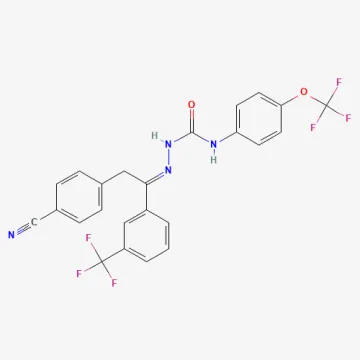
Metaflumizone
Description
Mode of action
Metaflumizone belongs to the semicarbazone chemical class. It is a unique active ingredient that acts as a sodium channel blocker in the insect nervous system, which distinguishes it from pyrethroids and other insecticide groups.
The mechanism of action involves blocking sodium channels in the relaxed state. This leads to the rapid cessation of feeding, paralysis, and the subsequent death of the insect within a few days.
The product exhibits pronounced contact and stomach action. Upon contact with leaf surfaces or ingestion of treated plant tissues, the insect receives a lethal dose, making the treatment effective across a wide temperature range.
One of the key features is its high selectivity for Lepidoptera pests. The substance effectively suppresses populations at various developmental stages, including later larval instars that are often resistant to other insecticides.
Due to its specific mode of action, metaflumizone is characterized by a low level of cross-resistance in harmful organisms. This allows for its successful use in rotation programs to combat resistant lines of Lepidoptera.
What it targets
The main purpose of metaflumizone is to control pests from the order Lepidoptera. It effectively destroys larvae of various species of cutworms, moths, leafrollers, and other harmful insects.
The product is widely used to protect vegetable crops, such as tomatoes, cabbage, and eggplants, from a complex of caterpillars that damage both foliage and generative plant organs.
In field agriculture, metaflumizone is used on corn and soybean crops to control the damage caused by the cotton bollworm, meadow moth, and other economically significant insect species.
The agent is also used in fruit farming when there is a need to control specific fruit pests that show high tolerance to traditional insecticides.
- Cutworms (including cotton bollworm and Spodoptera)
- Meadow moth
- Leafrollers
- Diamondback moth
- Grape vine moth
Rates and timing
Application rates of metaflumizone depend on the pest species, population density, and crop type. They typically range from 0.2 to 0.5 liters of the product per hectare.
Optimal timing for treatment coincides with the period of mass egg hatching. Early detection of pests allows for maximum biological efficacy and prevents economically significant crop losses.
An important factor during application is the quality of leaf surface coverage. It is necessary to ensure uniform distribution of the spray solution, including the undersides of leaves where pests often concentrate.
The frequency of applications is determined by the economic threshold. In conditions of high pest population, it is recommended to maintain an interval of 7–14 days between treatments, according to the manufacturer's label.
When preparing tank mixes, it is essential to consider the compatibility of the product with other pesticides. A pre-test for sedimentation is recommended, as the metaflumizone formulation requires a stable spray mixture composition.
Restrictions
When working with metaflumizone, it is necessary to use standard personal protective equipment: gloves, protective clothing, goggles, and respirators to prevent contact with skin and mucous membranes.
The substance is moderately hazardous to bees, so treatments should be performed in the evening or early morning when pollinator activity is minimal. Buffer zones from apiaries must be strictly observed.
To prevent the development of resistance, it is not recommended to use the product more than twice per season on a single crop. It should be rotated with insecticides from other chemical classes.
Do not allow the product or its residues to enter water bodies, as the substance may have a negative impact on aquatic organisms. Follow sanitary rules for the disposal of containers and leftover spray solutions.
The pre-harvest interval varies depending on the crop and averages between 7 and 21 days. Always refer to the official label of the specific product before application.
Status in the European Union
Not approved in the EU
- CAS number
- 139968-49-3
- Category (EU)
- IN - Insecticide
- Approved from
- 01.01.2015
- Approval until
- 31.12.2024
- ADI
- 0.01 mg/kg bw/day
- ARfD
- 0.13 mg/kg bw
- AOEL
- 0.01 mg/kg bw/day
EU status is for reference only and does not replace national registration in your country.