
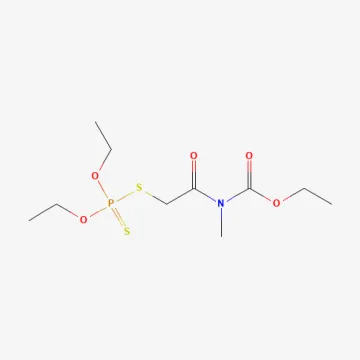
Mecarbam
Description
Mode of action
Mecarbam belongs to the organophosphorus (OP) class of chemicals, serving as a potent systemic and contact insecticide and acaricide. The substance works by interfering with the nervous system of pests, leading to rapid paralysis.
The primary mechanism of action involves the inhibition of acetylcholinesterase, an enzyme essential for nerve impulse transmission. By blocking this enzyme, mecarbam causes an accumulation of acetylcholine, leading to continuous nerve firing and the eventual death of the target organism.
Mecarbam is known for its ability to be absorbed by plant tissues, which provides systemic protection against pests. This property is crucial for reaching insects that feed internally or on the undersides of leaves, where direct contact is difficult.
The substance performs reliably under various environmental conditions, including temperature fluctuations. However, its stability can be influenced by the pH levels of the water used for spray preparation, requiring proper buffering if necessary.
Effective management requires thorough coverage of the foliage to ensure the active ingredient is absorbed evenly. This systemic behavior helps protect new growth that develops shortly after the application, prolonging the residual effect.
What it targets
Mecarbam is utilized to manage a wide range of sucking and chewing insects, as well as several mite species. It is particularly effective against aphids, thrips, and various scale insects.
It plays a significant role in mitigating infestations of phytophagous mites, including spider mites and fruit mites. The chemical's ability to interfere with the mites' life cycle helps reduce population growth significantly.
The product is also effective against leaf-mining insects that would otherwise be shielded from contact-only pesticides. Its systemic mobility allows it to reach these pests deep within the leaf parenchyma.
Common application areas include:
- Orchards, specifically for controlling mite populations on pome fruits.
- Citrus groves to eliminate scale and other sucking pests.
- Vegetable crops where systemic protection is required to ensure yield quality.
Rates and timing
Application rates for mecarbam vary based on the specific crop and the severity of the pest outbreak. Typically, the active ingredient concentration in the spray mixture ranges from 0.05% to 0.1%.
The timing of application should be synchronized with the early stages of pest life cycles. Preventive monitoring is essential to avoid reaching economic thresholds that would cause irreversible crop damage.
Repeated applications may be necessary depending on the length of the growing season and pest pressure, with a standard interval of 10–14 days. Proper rotation with other modes of action is recommended to prevent resistance development.
Restrictions
As an organophosphorus compound, mecarbam is highly toxic to humans and mammals. Personnel handling the concentrate must wear complete personal protective equipment, including respirators and chemically resistant gloves.
The substance is extremely toxic to bees and beneficial predatory insects. Applications must be avoided during bloom or when pollinators are active, and spraying should be scheduled to minimize drift to non-target areas.
Strict pre-harvest intervals (PHI) must be observed to ensure that chemical residues in harvested crops remain below established safety levels. Failure to comply with these intervals poses risks to consumers.
Environmental precautions are critical, including the prevention of runoff into water bodies. All containers must be disposed of in accordance with national regulations for hazardous waste, and empty containers should never be reused.
Status in the European Union
Not approved in the EU
- CAS number
- 2595-54-2
- Category (EU)
- IN - Insecticide
- ADI
- 0.002 mg/kg bw/day
EU status is for reference only and does not replace national registration in your country.