
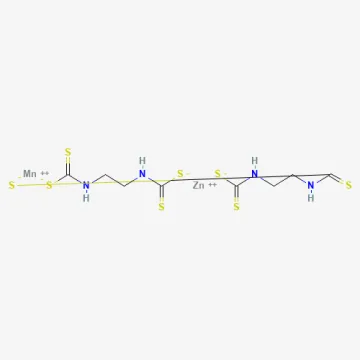
Maneb
Description
Mode of action
Maneb is a broad-spectrum contact fungicide belonging to the ethylene bisdithiocarbamate class. It acts as a protective barrier on the surface of plant tissues, preventing fungal spores from germinating and penetrating the plant cells.
The mechanism of action involves the inhibition of various enzymes within the fungal cells, particularly those containing sulfhydryl groups. This interruption of metabolic processes effectively kills the pathogen upon contact.
As a non-systemic agent, Maneb remains on the surface of the plant. Therefore, it does not provide curative action inside the plant tissue and must be applied preventatively before the fungal infection establishes itself.
Due to its multi-site mode of action, Maneb is an excellent tool for resistance management. It makes it very difficult for fungal populations to develop tolerance, as they would need to evolve multiple mutations simultaneously.
The durability of the protective film formed by Maneb depends on the formulation and the adherence to the leaf surface. Proper application technique is crucial to ensure that all vulnerable plant parts are covered.
What it targets
Maneb is used to control a wide variety of fungal diseases, including early and late blight in potatoes and tomatoes, anthracnose, leaf spots, and various rusts and mildews affecting agricultural crops.
It is widely utilized in the cultivation of vegetables, fruits, and field crops. By suppressing the development of pathogens like downy mildew and Septoria, it helps maintain high crop quality and yield.
The fungicide is also effective against various fruit tree diseases, including scab and other blights. It is often employed in integrated pest management (IPM) programs to protect both foliage and fruit.
Maneb's broad activity profile makes it a versatile solution for farmers managing multiple crop types. It serves as a reliable guard against common seasonal infections triggered by humid weather.
Furthermore, its efficacy extends to controlling various seed-borne pathogens when used as a seed treatment, ensuring better germination and initial plant establishment in the field.
Rates and timing
Application rates are determined based on the specific crop, the intensity of disease pressure, and the growth stage. It is essential to follow the specific label instructions provided by the manufacturer for each formulation.
Applications should be repeated at intervals of 7 to 14 days. During periods of frequent rain, the frequency of application may need to be increased to maintain a protective layer on the plant surface.
The use of properly calibrated sprayers is critical to achieve uniform coverage. Fine droplets ensure that the active ingredient adheres evenly to the foliage, which is necessary for effective protection.
The tank mix should be prepared just before use. Avoiding prolonged storage of the diluted mixture is key to maintaining the chemical integrity and efficacy of the fungicide.
Pre-harvest intervals (PHI) must be strictly observed to ensure that chemical residues on the final product are within the safety limits established by food quality standards.
Restrictions
Maneb is toxic if ingested or inhaled and can cause skin and eye irritation. Personnel handling the substance must wear appropriate personal protective equipment, including respirators, gloves, and protective clothing.
Compatibility is a major consideration; Maneb should not be mixed with highly alkaline substances, such as lime sulfur or Bordeaux mixture, as this will lead to the decomposition of the active ingredient.
Environmental precautions must be taken to prevent the contamination of water bodies. Drift during spraying should be avoided to protect nearby non-target vegetation and aquatic life.
Storage should be in a cool, dry, and well-ventilated area, away from reach of children and animals. Containers must be kept tightly closed and clearly labeled to avoid misuse.
Workers should avoid re-entering treated areas until the spray residue has completely dried and the restricted entry interval (REI) has expired, in accordance with local agricultural regulations.
Status in the European Union
Not approved in the EU
- CAS number
- 8018-01-7
- Category (EU)
- FU - Fungicide
- Approved from
- 01.07.2006
- Approval until
- 31.01.2017
- ADI
- 0.05 mg/kg bw/day
- ARfD
- 0.2 mg/kg bw
- AOEL
- 0.03 mg/kg bw/day
EU status is for reference only and does not replace national registration in your country.