
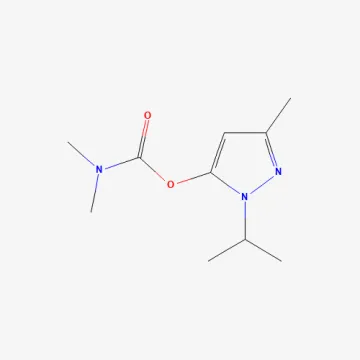
Isolane
Description
Mode of action
Isolan belongs to a group of carbamate-based compounds that act as powerful insecticides. These substances function by primarily targeting the nervous system of insects, effectively inhibiting the enzyme acetylcholinesterase, which is crucial for neurotransmission.
By blocking this enzyme, the chemicals prevent the breakdown of neurotransmitters, causing a continuous excitation of the nervous system. This results in rapid paralysis and the eventual death of the target pest shortly after exposure or ingestion.
A key characteristic of this chemical class is its systemic mobility within plant tissues. Once absorbed by the foliage or root system, the active ingredient is translocated throughout the plant, offering long-lasting protection against various types of herbivorous insects.
The speed of action is a distinct advantage, as it provides a quick knockdown effect against active infestations. This makes these compounds highly suitable for integrated pest management (IPM) programs where an immediate reduction in pest populations is required to prevent yield loss.
While effective, the biological degradation of these substances in the environment occurs through hydrolysis and microbial activity. However, they remain highly potent, and application timing must be managed carefully to ensure efficacy while minimizing environmental impact.
What it targets
The spectrum of activity for the Isolan group is broad, targeting a wide range of sucking and chewing insects. They are primarily utilized in field crops, horticultural plants, and greenhouses to control pests that are typically difficult to eradicate with contact-only products.
These insecticides are highly effective against various species of aphids that threaten cereal crops, vegetables, and fruit orchards. They are also widely used to control whiteflies, which are notorious for their ability to spread viral diseases in agricultural settings.
In addition, the group shows excellent efficacy against leaf-mining insects and certain species of beetles, such as the Colorado potato beetle. Their systemic nature allows the chemicals to reach pests hidden within plant structures, such as leaf mines or stems.
They are also a standard tool for managing populations of scales and mealybugs, particularly in nursery production and perennial crop management. By controlling these pests during the early stages of their life cycle, growers can significantly reduce crop damage.
- Aphids
- Whiteflies
- Leaf miners
- Scales and mealybugs
- Various beetle species
Rates and timing
Application rates generally range between 0.5 and 1.5 liters per hectare, depending on the pest pressure and the crop type. Growers should calibrate their equipment to ensure the correct amount of active ingredient reaches the target canopy for optimal systemic uptake.
The best results are achieved when applications are timed according to economic threshold monitoring. It is recommended to apply the product during the early morning or late evening hours to avoid high temperatures that could lead to rapid evaporation or reduced plant absorption.
The use of spray surfactants or adjuvants is often recommended to improve the coverage and penetration of the chemical through the plant's cuticle. This is especially important for crops with waxy leaf surfaces that may otherwise resist absorption.
Compatibility testing is essential before mixing with other crop protection products. Isolan-based formulas are often sensitive to alkaline conditions, which can lead to rapid hydrolysis and loss of active ingredient effectiveness in the spray tank.
Adherence to the recommended pre-harvest interval (PHI) is critical to ensure that residue levels in the final produce remain within acceptable legal limits. Farmers should maintain accurate records of every application to manage residue compliance effectively.
Restrictions
These compounds are highly toxic to honeybees and other beneficial pollinators. Consequently, applications must be strictly avoided during the crop's flowering period to protect local bee populations and maintain ecosystem balance.
Operator safety is a top priority; users must wear personal protective equipment (PPE), including chemical-resistant gloves, respirators, and eye protection, to prevent accidental exposure during mixing and loading processes.
Environmental stewardship requires keeping a buffer zone around water bodies, residential areas, and livestock grazing fields to prevent drift. Application should not occur during high-wind conditions, as spray drift can contaminate unintended areas.
After treatment, all application equipment must be cleaned thoroughly, and wastewater should be disposed of in a manner that prevents soil and water contamination. Following local regulations regarding hazardous waste disposal is mandatory for all empty pesticide containers.
Storage must be in a cool, dry, and well-ventilated location, inaccessible to children, unauthorized persons, and animals. Keeping the product in its original, sealed container prevents chemical degradation and helps maintain the efficacy of the pesticide over time.
Status in the European Union
Not approved in the EU
- CAS number
- 119-38-0
- Category (EU)
- IN - Insecticide
EU status is for reference only and does not replace national registration in your country.