
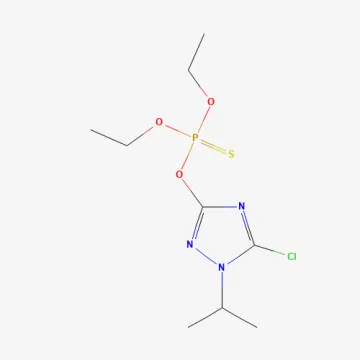
Isazofos
Description
Mode of action
Isazofos belongs to the chemical class of organophosphates. It functions as a contact and stomach insecticide and nematicide, demonstrating systemic properties when applied to soil.
The mechanism of action involves the inhibition of the enzyme acetylcholinesterase in the nervous system of insects and nematodes. This leads to the accumulation of acetylcholine in the synaptic clefts, causing continuous nerve impulse excitation, paralysis, and eventual pest death.
In the soil environment, isazofos exhibits moderate persistence, allowing it to effectively control soil-borne pests for a specific period after application.
The active ingredient can move within the root zone, providing protection for the root systems of young plants against damage from harmful organisms.
Due to its high toxicity to many living organisms, the use of isazofos requires strict adherence to regulations established by pesticide safety authorities.
What it targets
The primary use of isazofos is the control of soil-dwelling pests and phytoparasitic nematodes that cause significant damage to the root systems of agricultural crops.
The preparation is effective against various species of root-knot nematodes (Meloidogyne spp.), which affect vegetable crops and root vegetables.
The agent demonstrates high biological activity against larvae of scarab beetles, wireworms, and other soil-dwelling insects that damage the underground parts of plants.
It is applied to protect vegetable plantations, ornamental plants, and certain industrial crops that are susceptible to attacks by root parasites.
Due to its specific properties, isazofos helps prevent yield losses and quality degradation caused by plant suppression following root injury.
Rates and timing
Application rates of isazofos depend directly on the soil type, the level of pest infestation in the field, and the specific agricultural crop being cultivated.
The product is most commonly applied to the soil just before sowing or planting, or by incorporation into the rows to ensure maximum contact with the root system.
When using granular formulations, it is crucial to ensure uniform distribution across the treated area, as this directly affects the efficiency of nematode control.
Pre-harvest intervals must be strictly observed to avoid the accumulation of residual amounts of the active ingredient in the final produce.
Specific dosages are determined by the instruction label for each individual isazofos-based product, as the concentration of the active component may vary.
Restrictions
Isazofos is classified as a highly toxic compound to humans, warm-blooded animals, bees, and aquatic organisms, therefore requiring extreme caution.
When handling this substance, the use of a complete set of personal protective equipment, such as protective coveralls, gloves, respirators, and specialized footwear, is mandatory.
Treatments near water bodies, drinking water sources, and apiaries are prohibited due to the significant risk the pesticide poses to ecosystems.
Storage must be carried out exclusively in original manufacturer packaging within cool, dry, and secure warehouse facilities inaccessible to unauthorized personnel.
Disposal of remaining product and empty containers must be conducted in accordance with local legal requirements for handling hazardous waste.
Status in the European Union
Not approved in the EU
- CAS number
- 42509-80-8
- Category (EU)
- IN - Insecticide
EU status is for reference only and does not replace national registration in your country.