
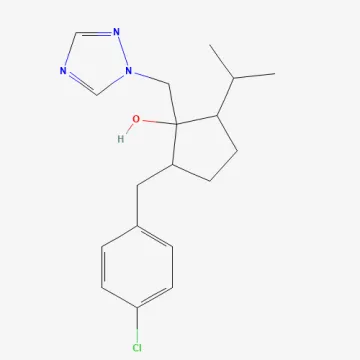
Ipconazole
Description
Mode of action
Ipconazole belongs to the triazole chemical class and acts as a systemic fungicide with a broad spectrum of activity. Its primary mode of action is the inhibition of ergosterol biosynthesis, a vital component of fungal cell membranes.
The disruption of ergosterol synthesis leads to the degradation of fungal cell walls and the inhibition of fungal growth. Ipconazole effectively blocks mycelium and spore development both on the seed surface and within the seed, providing reliable protection during the critical germination phases.
The substance exhibits a strong systemic effect, quickly penetrating embryo tissues and translocating throughout the seedling. This enables the protection of young plants from soil-borne pathogens that can cause significant yield losses during the early stages of vegetation.
A distinctive feature of ipconazole is its high selectivity, allowing it to effectively target a wide range of fungal diseases without significantly hindering the physiological processes of the host plant itself.
Unlike some other triazoles, ipconazole exerts a milder effect on seedling growth, making it a preferred component for many complex commercial seed treatments.
What it targets
Ipconazole is primarily utilized to combat a complex of seed-borne and soil-borne diseases. The main targets include various species of smut, such as loose smut and covered smut in cereal crops.
The active substance effectively suppresses the development of Fusarium and Helminthosporium root rots. These diseases often cause stand thinning and reduced productive tillering during the early growing period.
The spectrum of action also includes seed mold caused by various fungal species (e.g., Aspergillus, Penicillium, Mucor), which can drastically reduce germination rates under high-moisture storage conditions.
Ipconazole is actively applied against net blotch in barley, which is transmitted via seeds and crop residues. Using this active ingredient helps prevent early infection of young leaves.
In agronomic practice, ipconazole is frequently included in tank mixtures with other fungicides to expand the spectrum of activity and prevent the development of pathogen resistance.
Rates and timing
The application rate of ipconazole depends directly on the formulated product and the level of predicted infection pressure on the seed lot. Typically, the substance is applied as part of concentrated suspensions for pre-sowing treatment.
An important factor in determining timing is the moisture content of the seeds before treatment. Seeds must be cleaned of debris and dust to ensure the uniform distribution of the active ingredient across the seed coat.
During industrial seed treatment, the flow rate of the working solution per ton of seeds is strictly monitored. Insufficient dosage reduces efficacy against deep-seated infections, such as the causal agent of loose smut.
It is recommended to apply ipconazole immediately before sowing or in advance, provided that the treated grain is stored in dry, well-ventilated storage facilities.
Overdosing should be avoided when treating seeds with low vigor, as this may negatively impact germination energy under stressful environmental conditions.
Restrictions
Ipconazole is a moderately hazardous compound for warm-blooded animals and bees. Personal protective equipment, including respirators, gloves, and safety goggles, must be used when handling the product.
It is strictly prohibited to use treated seeds for human consumption or as animal feed. Treated grain must be clearly labeled and stored separately from food and feed products.
In case of skin or mucous membrane contact, rinse the affected area with plenty of running water. If swallowed, seek immediate medical attention.
Environmental restrictions include a prohibition on discharging residues of the working solution into water bodies or sewage systems, as the substance may be toxic to aquatic organisms.
When storing products based on ipconazole, adhere to the temperature ranges specified by the manufacturer to prevent the degradation of the active substance and the loss of its fungicidal properties.
Status in the European Union
Not approved in the EU
- CAS number
- 125225-28-7
- Category (EU)
- FU - Fungicide
- ADI
- 0.015 mg/kg bw/day
- ARfD
- 0.015 mg/kg bw
- AOEL
- 0.015 mg/kg bw/day
EU status is for reference only and does not replace national registration in your country.