
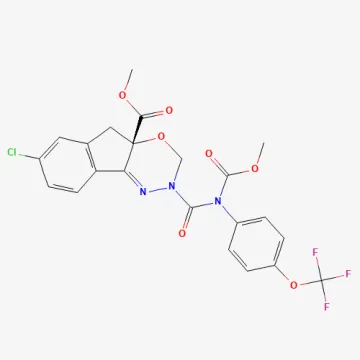
Indoxacarb
Description
Mode of action
Indoxacarb belongs to the oxadiazine chemical class and serves as a highly potent insecticide with contact and stomach action.
It is classified as a pro-insecticide, meaning it requires bioactivation within the target organism to reach its full toxic potential.
Inside the insect, specific enzymes convert indoxacarb into an active metabolite that selectively blocks sodium channels in nerve cells.
This disruption of nerve impulses causes the pest to stop feeding almost immediately, followed by paralysis and eventual death within 1 to 3 days.
The compound is characterized by its high selectivity, showing significantly lower toxicity to beneficial non-target insects compared to many older insecticides.
What it targets
The primary targets for indoxacarb are lepidopteran larvae, including various species of moths, caterpillars, and leafrollers.
It is exceptionally effective against pests such as the cotton bollworm, tomato fruitworm, and various diamondback moth populations.
Indoxacarb is commonly used to control hidden pests that bore into plant structures, providing protection for internal fruit tissues.
It is extensively applied to a wide range of vegetable crops, as well as field crops like corn, sunflowers, and potatoes.
The substance is a key tool in resistance management programs, successfully controlling pest populations resistant to pyrethroids and carbamates.
Rates and timing
Application rates for indoxacarb depend on the pest species, the severity of the infestation, and the specific crop growth stage.
Effective control is best achieved when the product is applied during the early larval stages of the target pests.
Uniform coverage of the crop canopy is essential to ensure that the pest consumes or contacts a sufficient dose of the active ingredient.
The number of seasonal applications must be restricted to comply with local regulations and to maintain the long-term effectiveness of the active ingredient.
Pre-harvest intervals (PHI) must be strictly followed to ensure that residues on food crops remain within safe, government-regulated limits.
Restrictions
While indoxacarb is generally considered safe for beneficial arthropods, it should not be applied directly when pollinators are active.
The stability of the active ingredient is pH-dependent, and using water with an optimal pH level is recommended to prevent chemical hydrolysis.
Mixing indoxacarb with alkaline pesticides should be avoided, as it can significantly reduce the stability and efficacy of the insecticide.
Standard personal protective equipment (PPE) is required during handling and application to minimize risks to the operator.
Integrated Pest Management (IPM) practices should be followed, including rotating indoxacarb with insecticides of different classes to prevent resistance buildup.
Status in the European Union
Not approved in the EU
- CAS number
- 173584-44-6
- Category (EU)
- IN - Insecticide
- Approved from
- 01.04.2006
- Approval until
- 19.12.2021
- ADI
- 0.005 mg/kg bw/day
- ARfD
- 0.005 mg/kg bw
- AOEL
- 0.003 mg/kg bw/day
EU status is for reference only and does not replace national registration in your country.