
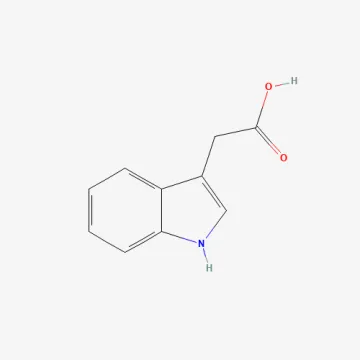
Indolylacetic acid
Description
Mode of action
Indole-3-acetic acid (IAA) is the most prominent naturally occurring auxin, a class of plant hormones that are essential for regulating various developmental processes throughout a plant's life cycle.
Its primary mechanism involves stimulating cell elongation by activating proton pumps in the cell membrane, which lowers the pH of the cell wall, making it more flexible and allowing it to expand under internal turgor pressure.
IAA plays a critical role in apical dominance, where the primary shoot tip inhibits the growth of lateral buds, ensuring that the plant allocates resources efficiently towards vertical growth.
In addition to cell elongation, IAA promotes cell division in the meristematic zones, which is vital for root initiation, vascular tissue differentiation, and fruit development.
Unlike synthetic auxins, IAA is rapidly metabolized within the plant, which makes it a transient but powerful signal for physiological changes, requiring precise application timing in agricultural practices.
What it targets
IAA is primarily used in commercial agriculture and horticulture as a rooting hormone to stimulate the development of adventitious roots in cuttings and graft unions.
It is widely applied in seed technology to improve seed germination rates and ensure uniform seedling emergence by stimulating the initial development of the radicle.
The substance is effectively used to alleviate transplant shock in vegetable and ornamental crops, promoting rapid root system regeneration upon planting in the field.
IAA application is also utilized to improve fruit set and prevent premature abscission (dropping) of flowers and young fruits under stressful environmental conditions.
It acts as a tool to rehabilitate plants that have suffered from mechanical damage or abiotic stress, encouraging the plant to resume normal vegetative growth.
Rates and timing
The application rate must be strictly calibrated based on the crop type and the physiological stage, as the dosage-response curve for auxins is highly specific and can shift from promotion to inhibition.
For rooting cuttings, aqueous solutions of specific concentrations are typically used for a soak treatment lasting several hours to allow adequate hormone uptake by the tissue.
For seedling transplantation, root zone drenching is recommended immediately after planting to facilitate the immediate establishment of the root-soil interface.
The preparation must be mixed immediately before use, as the molecule is unstable and degrades rapidly when exposed to environmental factors like light and temperature.
- Ensure water for mixing is at room temperature to avoid shock.
- Avoid mixing with highly alkaline substances or heavy metal ions.
- Maintain at least a 7 to 10-day interval between repeat treatments.
Restrictions
The major constraint of IAA is its extreme sensitivity to ultraviolet (UV) radiation, necessitating application during late afternoon or cloudy conditions to prevent photochemical degradation.
It should not be applied during the plant's dormancy phase, as the hormonal pathways are inactive, potentially leading to wasted resources or unintended side effects.
Excessive concentrations can lead to negative feedback loops, causing distorted growth, leaf curling (epinasty), or an unintended inhibition of stem growth.
Storage must be in a cool, dark, and dry environment within the original sealed packaging to maintain the integrity of the active ingredient.
The product must be kept out of reach of children and livestock, adhering to standard safety protocols for agricultural chemical handling and storage.
Status in the European Union
Not approved in the EU
- CAS number
- 87-51-4
- Category (EU)
- PG - Plant growth regulator
EU status is for reference only and does not replace national registration in your country.