
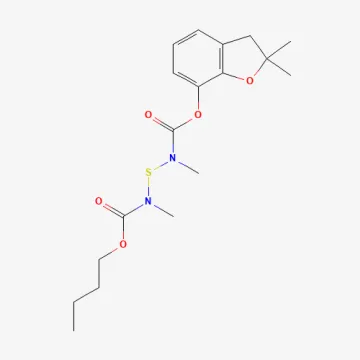
Furathiocarb
Description
Mode of action
Furathiocarb belongs to the carbamate chemical class and acts as a systemic insecticide with both contact and stomach action against a broad range of pests.
The primary mode of action is the irreversible inhibition of the enzyme acetylcholinesterase, which disrupts the nervous system function of insects, leading to paralysis and death.
Due to its systemic properties, the compound is readily absorbed by seeds and roots, translocating through the xylem to protect emerging seedlings from early-season attack.
It provides a long-lasting protective zone around the developing plant, which is crucial for establishing a healthy crop in environments with high pest pressure.
The compound's efficacy is influenced by its ability to persist in the root zone, ensuring continuous protection against subterranean feeders during critical growth stages.
What it targets
Furathiocarb is primarily utilized for the control of soil-dwelling pests that cause damage to seeds and seedling roots.
Key target organisms include wireworms, false wireworms, larvae of scarab beetles, and cutworms that inhabit the topsoil layers.
The substance also demonstrates efficacy against various sucking and leaf-feeding insects, including aphids and flea beetles that threaten young plants.
Its application is standard for field crops such as corn, sugar beets, sunflowers, and potatoes to ensure uniform stand establishment.
By targeting the underground pest complex, furathiocarb helps prevent crop thinning and loss of plant density caused by larval feeding.
Rates and timing
Application rates for furathiocarb are determined based on the specific crop requirements, seed quality, and anticipated soil pest population density.
The product is typically applied as a seed dressing, requiring calibrated seed treatment machinery to ensure uniform coverage across the seed surface.
Timing of application is usually integrated into the pre-planting seed preparation phase to maximize efficiency and convenience for farm operations.
Agronomists must ensure precise dosage adherence to prevent any potential negative impact on seed germination and seedling vigor.
Specific field conditions, such as soil moisture and texture, may influence the required application rate to achieve optimal residual protection.
Restrictions
Furathiocarb is classified as a highly toxic substance, requiring rigorous use of personal protective equipment (PPE) during handling and mixing.
Direct exposure to water sources must be strictly avoided to prevent environmental contamination and toxicity to aquatic life.
The pesticide is toxic to bees and other beneficial insects, meaning that dust from treated seeds should be kept away from flowering weeds or crops.
Storage of the chemical must be in a secure, well-ventilated, and locked area, inaccessible to unauthorized personnel and out of reach of children.
Safe disposal of empty containers and washing water is mandatory in accordance with local regulations regarding toxic agricultural chemicals.
Status in the European Union
Not approved in the EU
- CAS number
- 65907-30-4
- Category (EU)
- IN - Insecticide
- ADI
- 0.0035 mg/kg bw/day
- ARfD
- 0.006 mg/kg bw
EU status is for reference only and does not replace national registration in your country.