
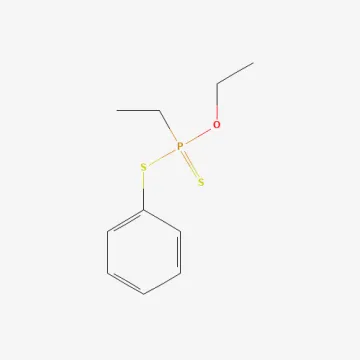
Fonofos
Description
Mode of action
Fonofos belongs to the organophosphate (OP) class of chemicals. It functions as a contact and stomach insecticide, exhibiting significant systemic action within the soil environment.
The primary mechanism of action involves the inhibition of the enzyme acetylcholinesterase in the insect's nervous system. This causes an accumulation of acetylcholine in the synaptic clefts, leading to continuous nervous stimulation, paralysis, and subsequent death of the pest.
Products based on this active ingredient demonstrate high initial activity, rapidly penetrating the pest's body upon contact or through the ingestion of treated soil particles and plant tissues.
Due to its lipophilic nature, fonofos binds well to soil colloids, creating a reliable "protective shield" around the root system or seeds of agricultural crops.
Fonofos is characterized by relatively high persistence in the soil, providing a prolonged period of protection essential for safeguarding young seedlings during their most vulnerable developmental phases.
What it targets
This substance is primarily used to control a complex of soil-dwelling pests that damage roots, seeds, and young shoots during the early stages of vegetation.
Key targets include larvae of scarab beetles, including grubs, as well as cutworm caterpillars that inhabit the topsoil horizon.
The product is highly effective against wireworms (click beetle larvae), which cause severe damage to root crops and row crops.
Fonofos is also used to control populations of mole crickets, which are capable of destroying a significant portion of crops on vegetable plantations.
The scope of application includes cereals, corn, sugar beets, potatoes, and open-field vegetable crops where the risk of pest damage is highest.
Rates and timing
Application rates for fonofos depend on the formulation type, soil texture, and the target pest, requiring the product to be applied directly into the furrow during planting.
Applying the product requires the use of specialized equipment (granule applicators) mounted on planters to ensure precise distribution of the substance in the root zone.
Soil moisture is a critical factor for effectiveness: in dry soil, the activity of the insecticide may decrease, making optimal timing of application essential.
To prevent the development of insect resistance, it is recommended to rotate fonofos-based products with insecticides from other chemical classes within the crop rotation.
Pre-harvest intervals must be strictly observed in accordance with the application regulations for specific crops to avoid the accumulation of residues in the final product.
Restrictions
Fonofos is highly toxic to warm-blooded animals and humans, requiring strict adherence to safety procedures during handling and loading operations.
When working with the product, the use of personal protective equipment for respiratory organs, skin, and mucous membranes is mandatory.
The use of fonofos is prohibited in water protection zones and near open water bodies due to its high toxicity to aquatic organisms and the risk of groundwater contamination.
Mixing with highly alkaline products is not permitted, as this can lead to rapid degradation of the active ingredient and loss of insecticidal properties.
Access for pets and poultry must be restricted in storage areas and zones where granular forms of the product are applied.
Status in the European Union
Not approved in the EU
- CAS number
- 944-22-9
- Category (EU)
- IN - Insecticide
EU status is for reference only and does not replace national registration in your country.