
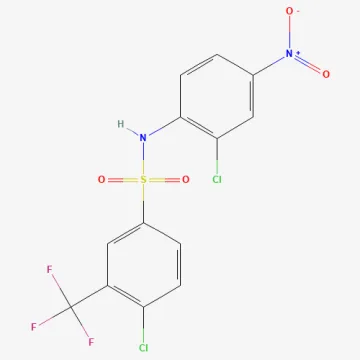
Flusulfamide
Description
Mode of action
Flusulfamide belongs to the sulfonamide chemical class and is a specialized contact-acting fungicide and nematicide. Its primary role is protecting plant root systems from soil-borne pathogens.
The mechanism of action is based on disrupting the energy metabolism within fungal and nematode cells. It inhibits mitochondrial activity by preventing oxidative phosphorylation, ultimately leading to organism death.
The substance possesses high lipophilicity, which allows it to remain effectively within the soil absorption complex, creating a reliable protective barrier around plant roots.
Unlike systemic preparations, flusulfamide does not translocate through plant tissues; however, it provides long-lasting protection by maintaining high concentrations in the rhizosphere.
The substance's action is characterized by a rapid initiation of the pathogen's biological response to the toxicant, preventing infection of young tissues during critical growth phases.
What it targets
The main purpose of flusulfamide is the control of dangerous soil-borne diseases such as clubroot (Plasmodiophora brassicae) and late blight in potatoes.
The substance effectively suppresses the activity of parasitic nematodes that cause serious damage to root crops and potatoes, leading to deformations and reduced market quality of the harvest.
Its spectrum of activity covers a wide range of soil-dwelling fungi capable of causing rot and attacking young seedlings immediately after germination.
Using this preparation helps significantly reduce crop losses caused by soil fatigue when susceptible crops are grown continuously on the same land.
- Plasmodiophora (clubroot)
- Potato late blight
- Root-knot nematodes
- Root rots
Rates and timing
Application rates for flusulfamide depend directly on soil type and the level of pathogen infestation. Lower concentrations are generally effective in light soils compared to heavy clay loams.
Application is typically performed before sowing or planting. The product is incorporated into the soil at the depth of the root system to achieve maximum biological efficacy.
A critical requirement is the uniform distribution of the active ingredient within the treated soil layer, which is achieved through proper cultivation immediately after application.
Pre-harvest intervals must be strictly observed in accordance with regional regulations to ensure that no harmful residues remain in the final agricultural produce.
When used in tank mixtures, a compatibility test is recommended, although flusulfamide is most commonly applied as a standalone soil treatment component.
Restrictions
Flusulfamide lacks systemic activity, meaning its effectiveness is strictly dependent on the quality of soil application and ensuring physical contact with the pathogen.
It is not recommended to apply the product to soils with very high organic matter content, as the active ingredient may bind to it, significantly reducing its biological activity.
The product requires rigorous safety measures during handling: the use of personal protective equipment for skin, eyes, and respiratory organs is mandatory to prevent toxic exposure.
Drift to adjacent crops must be avoided, as the active substance poses a risk to aquatic organisms and can have persistent effects in aquatic environments.
Post-application monitoring of the crops is advised to rule out any potential risk of phytotoxicity during unfavorable weather conditions.
Status in the European Union
Not approved in the EU
- CAS number
- 106917-52-6
- Category (EU)
- FU - Fungicide
EU status is for reference only and does not replace national registration in your country.