
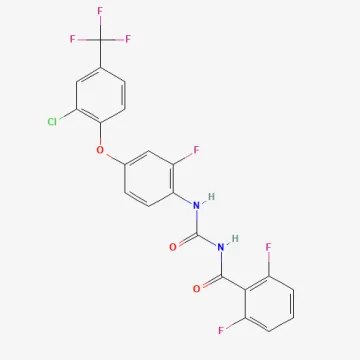
Flufenoxuron
Description
Mode of action
Flufenoxuron belongs to the benzoylurea chemical class and acts as a highly effective insect growth regulator (IGR). Its primary mode of action is the inhibition of chitin synthesis in arthropods.
When the substance enters the pest's body or makes contact, it disrupts the cuticle formation process during molting. Consequently, the insect cannot successfully shed its old exoskeleton, leading to death at various developmental stages.
The compound exhibits strong ovicidal activity, affecting pest eggs and preventing hatching. It also demonstrates translaminar activity, penetrating leaf tissues to protect areas not directly covered by the spray solution.
The product is characterized by a slow initial effect, as mortality occurs primarily during molting periods rather than immediately. However, it provides a long residual effect due to high resistance to wash-off by rain.
Flufenoxuron has limited direct impact on adult insects but significantly reduces their fecundity, making it an essential component of integrated pest management (IPM) programs to control pest population growth.
What it targets
The active ingredient has a broad spectrum of insecticidal and acaricidal activity. It is most effective against various mite species (spider mites, gall mites), lepidopteran pests (cutworms, moths, leafrollers), and certain whitefly species.
The product is recommended for controlling pests in apple orchards, vineyards, open and protected field vegetable crops, and ornamental plants susceptible to spider mite infestations.
Using flufenoxuron helps suppress populations that have developed resistance to organophosphates and pyrethroids due to its distinct mechanism of action on insect metabolism.
It is particularly valuable for controlling pests that reside in concealed areas, as its high penetrative ability allows it to act through plant tissues.
The efficacy against eggs and early-instar larvae makes it indispensable for preventing mass outbreaks of pests early in the growing season.
Rates and timing
Application rates for flufenoxuron depend on the crop type, pest pressure, and growth stage. Products based on this ingredient are typically used at concentrations ranging from 0.02% to 0.05% for orchard treatments.
Timing of applications should coincide with periods of peak egg-laying or the emergence of early-instar larvae. Early application maximizes the use of the product's ovicidal properties.
To achieve the best results, thorough and uniform coverage of the entire leaf surface is necessary, as the contact mode of entry is a critical factor in the product's effectiveness.
The number of applications per season is generally restricted to one or two to prevent the development of pest resistance. It is recommended to rotate flufenoxuron with products from other chemical classes.
The interval between applications in orchards is usually between 14 and 21 days, depending on weather conditions and the rate of vegetative growth, which influences the active substance concentration on the leaves.
Restrictions
Flufenoxuron is moderately toxic to mammals, but standard safety precautions for handling agrochemicals must be strictly followed. Personal protective equipment (PPE) for skin, eyes, and respiratory protection is required.
The product is relatively low in toxicity to many beneficial insects, including entomophages and bees, making it suitable for IPM programs where preserving biodiversity is a priority.
It is not recommended to apply the product during peak flowering periods if apiaries are located nearby, to avoid potential negative impacts on pollinators despite its moderate toxicity.
The active substance must not be allowed to enter water bodies, as it is highly toxic to aquatic life, particularly crustaceans. Respect buffer zones when spraying near aquatic areas.
Storage should be in original containers in a cool, dry place, away from unauthorized access and animals, in accordance with pesticide handling regulations.
Status in the European Union
Not approved in the EU
- CAS number
- 101463-69-8
- Category (EU)
- IN - Insecticide
- ADI
- 0.01 mg/kg bw/day
- ARfD
- Not appl.
- AOEL
- 0.01 mg/kg bw/day
EU status is for reference only and does not replace national registration in your country.