
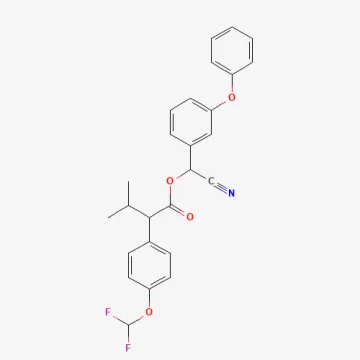
Flucythrinate
Description
Mode of action
Flucythrinate belongs to the synthetic pyrethroid class of insecticides. Similar to other members of this chemical group, it acts on the insect nervous system by disrupting the permeability of sodium channels in nerve cell membranes.
The mechanism of action involves delaying the closure of sodium channels, which triggers excessive excitation, paralysis, and rapid death of the target pest.
This insecticide exhibits strong contact and stomach action. It quickly penetrates the insect's cuticle, providing a rapid "knockdown effect" immediately after contact or ingestion of treated plant parts.
Products based on flucythrinate are known for their fast-acting properties, although their overall effectiveness is significantly dependent on ambient temperatures at the time of application.
Due to its high lipophilicity, the substance adheres well to plant surfaces, providing a certain period of residual protection, which may be limited by intense ultraviolet radiation.
What it targets
Flucythrinate is a broad-spectrum insecticide used to control a wide range of lepidopteran, coleopteran, and hemipteran pests in various agricultural crops.
Key targets for this active ingredient include leaf-eating caterpillars, cutworms, moths, and various beetle species that damage the vegetative organs of plants.
The pesticide is effective on grain crops, vegetables, orchards, and technical crops such as sugar beets or cotton.
Due to its chemical structure, the substance is capable of suppressing pest populations at different stages of development, including both larval and adult stages.
An important feature is its potential use against pests that have developed resistance to organophosphate pesticides, provided there is no cross-resistance.
Rates and timing
The application rate of flucythrinate depends on the specific target pest, the density of the infestation, and the growth stage of the crop being treated.
Spraying is recommended during the period of peak pest activity, specifically when populations reach or exceed the economic threshold for damage.
To ensure maximum efficiency, the spray solution must evenly cover the leaf surface, which necessitates precise calibration of spraying equipment.
The number of applications per season is strictly regulated to prevent residue accumulation in the final produce and to mitigate the risk of resistance development.
The pre-harvest interval must be strictly observed in accordance with local pesticide regulatory standards to ensure consumer safety.
Restrictions
When using flucythrinate, it is crucial to consider its high toxicity to beneficial insects and pollinators; therefore, applications should be conducted during evening hours or when pollinators are not active.
Application is not recommended during periods of extremely high temperatures, as the efficiency of many pyrethroids can decrease under heat stress due to rapid chemical degradation.
Flucythrinate must not be used near water bodies or fishing areas due to its high toxicity to aquatic life and fish populations.
Rigorous adherence to personal hygiene and the use of personal protective equipment are mandatory when preparing the working solution and during the spraying process.
For resistance management purposes, it is recommended to rotate the use of flucythrinate with insecticides that feature different modes of action and do not belong to the pyrethroid group.
Status in the European Union
Not approved in the EU
- CAS number
- 70124-77-5
- Category (EU)
- IN - Insecticide
- ADI
- 0.02 mg/kg bw/day
EU status is for reference only and does not replace national registration in your country.