
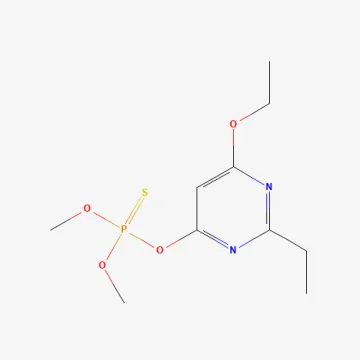
Etrimfos
Description
Mode of action
Etrimfos belongs to the organophosphorus (OP) chemical class. It acts as a contact and stomach insecticide, providing a wide spectrum of control against various harmful organisms.
The mechanism of action involves the inhibition of the acetylcholinesterase enzyme within the insect's nervous system. This disruption leads to the failure of nerve impulse transmission, resulting in paralysis and death.
The substance exhibits significant fumigant properties, which makes it highly effective for controlling hidden pests in enclosed environments or within dense plant canopies.
Due to its high lipophilicity, the active ingredient rapidly penetrates the insect's cuticle, ensuring a quick "knockdown" effect even under challenging weather conditions.
Etrimfos has moderate persistence, allowing it to be used effectively for both field treatments and the disinfestation of storage facilities when regulatory waiting periods are strictly observed.
What it targets
The spectrum of action covers a wide range of pests from the orders Lepidoptera, Coleoptera, Orthoptera, and Hemiptera. It is particularly effective against aphids, weevils, cereal beetles, moths, and various larvae.
In agriculture, its primary application is the protection of cereal crops from a complex of leaf-chewing and sucking insects during the vegetative growth phase.
An important application area is the use of etrimfos for the disinfestation of grain stores, elevators, and warehouses, where it demonstrates high efficacy against stored-product pests.
The substance successfully suppresses pest populations during periods of high density, preventing mass damage to the vegetative and generative organs of plants.
- Cereal crops (wheat, barley).
- Stored grain seeds and legumes.
- Empty storage warehouses and transport vehicles.
Rates and timing
Application rates vary depending on the level of infestation and the target pest species. For field applications, dosages are calculated based on the required spray volume per hectare.
Pre-harvest intervals (PHI) are strictly regulated, typically ranging from 20 to 30 days for field crops to ensure that residue levels in the final product remain below safety limits.
When treating stored grain, rates are defined by the amount of product per ton of grain, necessitating thorough and even distribution of the active ingredient.
Field treatments are conducted upon reaching the economic threshold of damage, preferably during morning or evening hours to avoid drift during high winds.
Repeat treatments are permissible if necessary, provided that etrimfos is rotated with insecticides from different chemical groups to mitigate the risk of pest resistance.
Restrictions
Etrimfos is highly toxic to bees and other beneficial entomophagous insects; therefore, application during the flowering stage of crops is strictly prohibited.
It is essential to maintain safety buffer zones from water bodies and apiaries, and to utilize full personal protective equipment when handling both concentrated and diluted forms.
Mixing restrictions apply: etrimfos should not be tank-mixed with strongly alkaline substances, as this can trigger chemical hydrolysis and significantly reduce the insecticide's efficacy.
Spray solutions should be applied within a few hours of preparation, as their stability may degrade over time when held in the spray tank.
When used in storage facilities, it is critical to monitor grain temperature and moisture, as storage conditions directly influence the degradation rate of the active ingredient.
Status in the European Union
Not approved in the EU
- CAS number
- 38260-54-7
- Category (EU)
- IN - Insecticide
- ADI
- 0.003 mg/kg bw/day
EU status is for reference only and does not replace national registration in your country.