
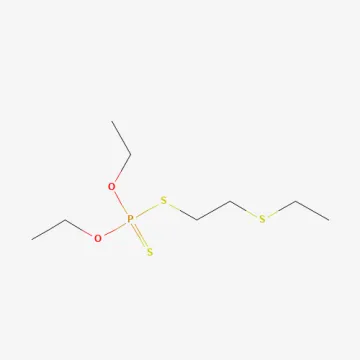
Disulfoton
Description
Mode of action
Disulfoton belongs to the organophosphate (OP) class of chemicals. It acts primarily as a systemic insecticide and acaricide, capable of being translocated through the vascular system of the treated plants.
The primary mechanism of action involves the inhibition of the enzyme acetylcholinesterase in the insect's nervous system. This causes the accumulation of acetylcholine at the synapses, leading to overstimulation of the nerves, paralysis, and eventual death of the pest.
The compound is rapidly absorbed by the plant's root system or foliage. Once inside the plant tissues, the active ingredient is translocated to all aerial parts, providing long-term protection for new growth.
Due to its high systemic activity, it effectively protects parts of the plant that were not directly sprayed, which is crucial for maintaining crop health during the active vegetation stage.
Unlike contact-only insecticides, the efficacy of Disulfoton is less dependent on direct physical contact with the insect. Pests receive a lethal dose when they ingest the sap of the treated plant.
What it targets
Disulfoton shows high efficacy against a wide range of harmful insects and mites that feed on plant sap.
Primarily, it is an essential tool for managing sucking pests, including aphids, leafhoppers, thrips, and various species of plant-feeding mites.
The product also exhibits activity against certain soil-dwelling pests when applied via soil incorporation during sowing or planting.
It successfully suppresses whitefly populations at early development stages, preventing leaf damage and the transmission of viral infections for which these pests act as vectors.
- Aphids (various species)
- Spider mites
- Thrips
- Leafhoppers
- Soil-dwelling pest larvae
Rates and timing
Application rates of Disulfoton vary depending on the crop type, method of application, and pest pressure, so always follow the specific product label guidelines.
For pre-sowing soil incorporation, rates are calculated based on row spacing and plant density to ensure uniform distribution of the active ingredient within the root zone.
Foliar applications should be performed during early morning or late evening hours in calm weather conditions to minimize drift and ensure optimal uptake by plant tissues.
Pre-harvest intervals (PHI) must be strictly observed to prevent the accumulation of organophosphate residues in harvested agricultural products.
The number of seasonal applications is strictly regulated to prevent the development of pest resistance and to avoid exceeding maximum residue limits (MRLs).
Restrictions
Disulfoton is highly toxic to humans, warm-blooded animals, as well as honeybees and other beneficial predatory insects.
The use of this product is strictly prohibited in buffer zones near water bodies and near apiaries during periods of active bee foraging due to high poisoning risks.
Full personal protective equipment (PPE) is mandatory when handling this substance, including respirators, gloves, protective clothing, and goggles to prevent skin and eye contact.
Given its systemic nature and environmental persistence, proper crop rotation and strict adherence to reentry intervals for manual or mechanized labor are essential.
In cases of large-scale use, it is highly recommended to rotate with insecticides from different chemical classes to slow down the development of resistance in pest populations.
Status in the European Union
Not approved in the EU
- CAS number
- 298-04-4
- Category (EU)
- IN - Insecticide
EU status is for reference only and does not replace national registration in your country.