
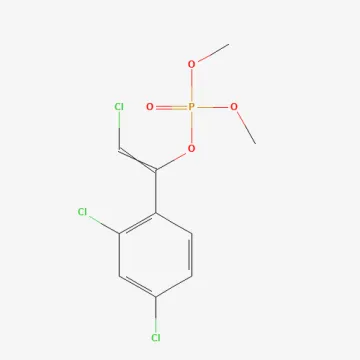
Dimethylvinphos
Description
Mode of action
Dimethylvinphos belongs to the organophosphate class of insecticides. Its primary mode of action is the inhibition of the enzyme acetylcholinesterase, which is essential for the normal functioning of the nervous system in insects and pests.
By preventing the breakdown of the neurotransmitter acetylcholine, the chemical causes its accumulation at nerve synapses. This leads to continuous, uncontrolled nerve impulses, resulting in paralysis and subsequent death of the target organism.
The substance possesses both contact and stomach poison characteristics, allowing it to be absorbed through the cuticle of the insect or ingested through treated plant tissues. This dual action makes it effective against various pest types.
This insecticide acts quickly, often providing a "knock-down" effect that stops plant damage shortly after application. This makes it a valuable tool during outbreaks of high-density insect populations.
Due to its mechanism of action, frequent use can lead to the development of pest resistance. Implementing Integrated Pest Management (IPM) practices, such as rotating dimethylvinphos with insecticides of different chemical classes, is crucial for long-term efficacy.
What it targets
Dimethylvinphos is widely used for controlling various Diptera, Lepidoptera, and Coleoptera species that cause significant damage to crops. It is specifically valued for its ability to target nuisance insects like house flies and biting flies.
In addition to agricultural fields, it is effectively used in animal husbandry and public health. It helps manage infestations of parasites in barns, stables, and poultry houses, improving overall hygiene and animal welfare.
It is also employed for protecting stored grain from pests such as weevils and flour beetles. By treating storage surfaces, it prevents post-harvest losses and maintains the quality of stored agricultural products.
The substance effectively targets various larvae that feed on foliage, providing essential protection for vegetables and field crops. It is an important tool for growers needing rapid control over leaf-eating caterpillars.
- House flies and stable flies
- Caterpillars (Lepidoptera)
- Stored product beetles
- Ectoparasites of livestock
Rates and timing
The application rates for dimethylvinphos vary significantly depending on the target pest, the application site (crops vs. structures), and the formulation type. Always follow the specific instructions on the product label for accurate dilution.
When applying to crops, it is essential to ensure full coverage of the foliage for maximum contact. Use calibrated spraying equipment to avoid uneven application and to minimize waste during the process.
Timing is critical for success; applications should generally be made when pests are most active but during periods of low wind to avoid drift. Morning or late afternoon applications are typically recommended to increase environmental stability.
Pre-harvest intervals (PHI) must be strictly observed to ensure the safety of the harvested produce. These intervals are determined based on residue data and vary by the type of crop treated.
Regular monitoring of pest populations is advised to determine the need for further applications. Economic thresholds should guide decision-making to avoid unnecessary environmental exposure and costs.
Restrictions
As an organophosphate, dimethylvinphos is toxic to humans and other mammals. Operators must wear appropriate Personal Protective Equipment (PPE), including gloves, goggles, and respirators, when handling or applying the product.
This substance is highly dangerous to bees and other pollinators. It should never be applied while crops are in bloom or when pollinators are actively foraging in the area to prevent mass mortality.
The product poses a high risk to aquatic organisms, including fish and aquatic invertebrates. Prevent runoff into streams, ponds, or other water bodies by maintaining appropriate buffer zones during spraying operations.
Compatibility with other pesticides should be checked prior to tank mixing. Alkaline compounds can speed up the hydrolysis of dimethylvinphos, significantly reducing its potency and effectiveness.
All storage and disposal must comply with local and national environmental regulations. Store in original containers in a cool, locked place and dispose of empty packaging through authorized chemical waste facilities.
Status in the European Union
Not approved in the EU
- CAS number
- 2274-67-1
EU status is for reference only and does not replace national registration in your country.